CMM1101 Reading Media Texts – the nexus between Western-world mass culture & Ameri/Euro-centric popular culture-mass media

CMM1101 Reading Media Texts    500 Words –  Tutorial Week 2.                Susanne Harford

The fascinating connections between Western-world mass culture, and Ameri/Euro-centric popular culture and the mass media, first described in the 1920s and 1930s, are sketched out by Strinati in (1995, p. 2). In this writing, although acknowledging the whole matter may have commenced much earlier in Europe, even as far back as ancient Rome (1995, p. 2), Strinati concentrates on three major streams (1995, p.3).

The three streams Strinati deals with are firstly; what or who determines popular culture, a matter still of great mystery and interest today; secondly, the emergence of culture in commodity forms , which probably means criteria such as ensuring profitability or marketability (within not only media product, but flowing through to the production of cultural artefacts, all the way through to all parts of everyday life) take precedence over maintaining quality, artistry, integrity and intellectual challenge within those influential fields. This leads Strinati to the question of whether there are intolerable levels of influence of commercialisation and industrialisation upon popular culture. The third point Strinati makes concerns the ideological role of popular culture. There are famous and well-known examples of this, such as the Nazi regime, and use of popular culture. (1995, p.3). Within those three major streams there are many interesting major points, and all the points are multi-faceted.

One point Strinati deals with when quoting Williams’ work is how in the 19th. C, popular culture underwent a radical ‘shift’, to allow the adoption into culture of the viewpoint of the common masses, where previously all historic, traditional cultural spheres were under the total control, one way or another, of distanced, elite groups. Strinati provides background to this development, with a brief and interesting outline with how the European positions, detailed in the 16th. and 17th. C  by writers such as Pascal and Montaigne, noted types of connection to the development of a “market economy” (Lowenthal, as quoted by Strinati, 1995, p.2). Strinati explains a very interesting section of this theory; that the continuing development of Western-world mass culture may possibly be connected with the rise of nationalism in 18th. C Europe, by incorporating the work of Burke (as quoted by Strinati, 1995, p. 2).

Another interesting point is:  Strinati stresses that, although clothed in all types of disguises this situation has been exposed from time to time, particularly by respected, learned – also by demoralised and disaffected writers, this situation has continued unabated.  Strinati’s position seems shared, during and after the Second World War in particular, by modern writers such as Hoffstead and Adorno, and later Hoggart, as quoted by Strinati, (p. 31). It appears they began the essential work of analysing this situation. These writers generally considered mass culture, popular culture and mass media this as a controlled and oppressive triangle of power.  Developing ideas such as those of Hodge and Kees, (1991), who state “social control rests on control over the representation of reality”. Strinati says: “it is clear that mass culture theory can and has accommodated the idea that democracy and education have been harmful developments because they have contributed to the pathological constitution of a mass society” (reader. p. 7). However, there are other writers who see a more positive view, such as Berman.

A further interesting point is: Strinati seems to be of the view that in the modern or post-modern Western world of today, the whole concept of ‘public virtue’ is virtually unknown, yet barely a hundred years ago, was it one of the major moral thrusts of patriarchal European thought, and to hold ‘popular culture and mass culture largely responsible.  While Strinati appears to think this the case in our affluent, privileged, still-patriarchal society today, how can that be so, when the reality many Western citizens are still very concerned with, and involved in trying to better the status of mankind generally ?

Strinati, D. (1995). Mass Culture and Popular Culture: An introduction to theories of popular culture. London: Routledge. Found in CMM1101 Reading Media Texts Book of Readings

Edith Cowan University Mt Lawley. Semester 1, 2010. Tutor Dr. J. Burton              Page 2 of 2

Aside

Strategic Event Event Plan – Executive Summary 2014


  1. Executive Summary 小美女 – Xiǎo měin (XM)

This Strategic Event Plan is to hold an Australian launch of women’s apparel designed by 小美女Xiǎo měin (XM). XM is Chinese and her business works from Shanghai, and online. As the briefing paper’s objective is to “make inroads into the Australian fashion market… beginning 2015” and the budget is small a compact and integrated mainly-online campaign will be run by two paid publicists. The event goal is to establish XM in the growing Australian fashion marketplace. Current research did not reveal any Chinese women’s fashion designer with an established presence in Australia today.

The communication goal is to incentivise individuals from the target audiences sufficiently “during and after the launch, [to visit] XM’s website… [to place] internet orders… directly from Shanghai”.

Demographics demonstrate a potential primary target audience pool of around 63,000 girl and lady customers, between 18 and 35 years of age, in the greater Perth region. A key secondary

audience is the Australian online shopper. This is a booming market, and is good as this IMC objective-based mainly-online campaign is based around XM’s already-successful, global e-business site.

So creating pre, during, and post-event environments for external and internal target audience members to exchange information about XM, and mingle with internal publics of key stakeholders; staff, volunteers, consultants, sponsors, and partners. The key stakeholder groups contain key secondary audiences: Chinese-Australian residents and visitors, fashion, design, media and drama students, etc.

The event concept, is that XM’s Australian launch, a photo-shoot at sunrise & sunset, will also work to welcome Chinese New Year (19 February 2015). At the second of the world’s top 10 beaches, Cottesloe Beach, WA, and regardless of on-the-day weather paid professionals, a beach and design

specialist photographer and a fashion photo stylist, will create a uniquely outdoor-Australian beach tableau, to showcase the designer’s recent garments and accessories, across several seasons.

Event planning was constrained by the small initial budget of $15,000 AUD cash. This figure was increased to $30,400 by in-kind contributions of $15,400: ECU equipment-lend, $400, S’Vow PR’s   services $5,000 and $10,000 marketing communication assistance, primarily by ECU,, The WA Chinese Consul office, Town of Cottesloe Council and Surf Life Savers. By November 2014, the publicists will create XM’s Australia Facebook, Flickr & Wiki sites aiming for fifty Australian 3rd-party Facebook visits and fashion blogger 3rd-party entries between 17 November 2014 and 17 March 2015. Regular press releases will be sent to general media publics, and important stakeholders who issue newsletters – ECU, the Chinese Consul office, Cottesloe Shire Council and Surf Life Savers.

Sponsor Edith Cowan University (ECU) will gain exclusive 2014/5 online and physical, badging/branding and total media rights to create, own, use media, and digital recording pre, on-day and post-event. ECU’s substantial communication network will inform their global student body about XM’s event and run the competition where students participate. ECU CareerHub will advertise for the publicists.

To begin inter-action with the Australian community, and create good-will, XM will sponsorCottesloe Surf Life Savers. For an initial period between November 2014 and Chinese New Year February 2016., XM will contribute to Cottesloe Surf Life Savers 10% of profit of online Australian sales and promote this worthy group on her Facebook & website. Only small twice-weekly ads will run in The West Australian. As this newspaper is another, major Cottesloe Surf Life Saving Club sponsor it may be possible to request some editorial about the XM’s event and her sponsoring of the Club.

Aside

2 page Strategic Event Plan – Strategy Development 2014

  1. Strategy Development 小美女 – Xiǎo měin (XM)

Your team is to develop a strategic event plan to guide the implementation of a special corporate event supporting the business goals of a corporate client. You will also develop a brief Sponsorship Proposal for an identified potential sponsor of this event.

  • Event and Communication Goals

Event Goal: The event goal for the Xiǎo měin 19 February 2015 launch event is to establish Xiǎo měin in the Australian physical and online fashion marketplace.

Xiǎo měins associated corporate goal is for her women’s fashion apparel business to be commercially successful in the burgeoning Australian physical and online marketplace.

Communication Goal: The communication goal is for Xiǎo měin’s cultural commodities to be understood, accepted and desired by the Australian physical and online marketplace.

  • Target Audiences and Key Stakeholders

Target Audiences: The Xiǎo měin event’s primary target audience is approximately 4 million middle-class Australian girls and ladies aged 18-35. Xiǎo měin is currently totally unknown in the Australian women’s fashion marketplace, so details and key features of this audience will emerge in time.

It is anticipated that this 2015 Perth event will generate interest in the approximately 60,000 members of that primary target audience who reside in the greater Perth region. In particular the key target market sectors of Chinese-Australians, students of fashion, design, media, and drama, humanities, and residents of the affluent suburbs that surround Cottesloe Beach, the area where the launch will be held. It may be possible to also attract affluent, in-bound Chinese fashion-loving travellers. Other key audiences are the media, and the huge, global, online audience, including via Wiki, Facebook, Flickr, Instagram and similar others.

Key Stakeholders: The key stakeholders of the Xiǎo měin are, firstly, Xiǎo měin herself, her business and those of her Shanghai business that become involved, her e-business site. In-coming sponsor ECU is important, and the student of ECU, both local and global, in particular all students who enter the competition and specifically the competition winners . Further key stakeholderss are Xiǎo měin’s personal sponsor-recipient the Cottesloe Surf Life Saving Club, The Office of the Chinese Consul in Perth, the Cottesloe Council, the 2 publicists employed to rung this campiagn, the photographer and photographic stylist. The freighting office and insurance company Xiǎo měin decides to use, and any in-situ Council operatives that oversee Cottesloe Beach, including emergency, fire and police services.

  • Primary & Key Secondary audience demographics & psychographics

Primary & Key Secondary audience demographics & psychographics: Are analysed in the initial pitch document, thereafter in the second presentation document. Details of the source information can be found in Appendices 1 & 2.

Strategy Development 小美女 – Xiǎo měin (XM)

  • Event Concept

The event concept: Simply put, this event concept is create a gentle ‘tableau’ of garment design fusing with nature: to present Chinese women’s fashion designer Xiǎo měin to the Australian women’s fashion market on the iconic Cottesloe Beach, WA, on a Chinese festival date that is well-accepted by Australians, and to invite the Australians to participate. T

Event Planner; what, where, who, when and how (3-page format as provided)

Aside

CMM113 Week 3. Discursive Pillars

In Western post-modern/modern society of Australia, Foucault’s model of discourse can be applied. One discursive pillar is provided by Australia’s powerful media. Australian government policy provides a second. The true intent is always hidden.

Foucault said western post-modern society created “discursive formations” to send highly structured, hidden messages to their populace. Hall’s definition of discourse is that which: “represent[s] the West, the Rest, and the relations between them”, and also “a particular kind of knowledge … [which] also limits the other ways in which the topic can be constructed” (Hall cited in Hall & Geiben Eds., 1992, p. 291).

Two media opinions, “School meals go halal in London” (Brown, The Australian, August 6, 2010. p. 11.) from The Times, London, describe firstly, the “forced adoption of foreign [Muslim food laws or ] religious practices” in certain London high-schools. The second, “Veil a relic of repressive culture” (Ali, The West Australian, August 6, 2010. p. 21), is a longer, critical analysis of some Muslim dress, stating: “Philosophically, Islamism is a revolt against modernism” This media creates Foucault’s ‘discursive formation’.

An outline of the writer, Dr Ameer Ali, is provided at the end of the article. The garments are described as:

the burqa and the niqab along with the male turban and long beard

are the representative symbols of this new threat, part of the “Islamist

intrusion… [whose] ultimate objective of establishing an Islamic world

order, [whereby] political Islam promotes the growth of parallel societies

in the West that are excluding Muslims from mixing with others ….

Dr. Ameer Ali is a former head of the Muslim Community Reference Group,

hand-picked after the London bombings to address Islamic extremism

and promote tolerance.

Although Dr. Ali concludes positively by challenging the ‘West’ to rise to the occasion and provide answers, the major tone of the article is ominous and negative.

Both dwell upon the spectre of the “Other” (Hall, 1996, p. 238). Currently Australian government –endorsed Muslim immigration, combined with the arrival of Muslim ‘boat people’, is a major negative form of ‘the Other’. Common collective knowledge includes threats of ‘Other’ to valued nationalist traditions, and associated freedoms. Policy caused conflict between already-established Anglo-Celts, and Italians, Yugoslavs. These were conflicts between Christians. Only small migrant numbers of other religions were allowed. By reporting new ‘Others’ may force change in areas as fundamentally important as freedom of choice – of food – and religion, the media become what Croteau and Hoynes calls “key sites where basic norms are articulated” (2003, p. 163).

Historically Anglo-Celt Australia has accommodated change, but not without anger and fear – and violence. Running important English-opinion at this time – clearly demonstrates the strong Anglo-Colonial power in Australia, but – perhaps since the ‘world global financial crisis, Australia has been sold off: the traditional Anglo-colonial control has changed. No longer the preferred Christian 53rd American state, – now Muslim Saudi Arabian vassal.

Reference:

Ali, A. (Friday, August 6, 2010). Veil a relic of repressive culture: The burqa and niqab are the products of a misogynist and patriarchal tribal system. Opinion: The West Australian. p. 21.

Brown, D. (Friday, August 6, 2010). School meals go halal in London. The Australian. p. World 11.

Croteau, D. & Hoynes, W. (2003). Media Society: Industries, images and audiences. London: Sage

Hall, S. Ed. (1997) Difference: Cultural representations and signifying practices. London: Sage.

  1. Hall, S. & Gieben, B. Eds. (1992). Formations of modernity: The West and the rest: Discourses and power. Cambridge: Polity Press.
Aside

CMM113 Week 10 blog. Right where they began to erode our rights in earnest.

CMM1113. Tutor James Hall. Student 10043898 Susanne Harford. Blog 4, Week 10

The Twain Shall Meet. Part 11.

Or

The Society and State that protect the rights of the individual to think and embody thought.

Just as Christianity followed the flag into the Orient during the colonial era, today political Islam is entering the Occident not only through its religious institutions such as the mosques and madras, but also through personalised symbols such as the female burqa and niqab and the male turban and long beard.

Ali, 2010, August 6, p. 21.

How then to recognize individuality and to reconcile it with its intelligent and by no means passive or merely dictatorial, general and hegemonic context?

Said, 1978, Introduction, p. 9.

Today’s Western societies learn much about themselves, about their western world, and about the East or Orient, via western mass media. The Western press is relatively free, and thus it is extremely easy, on any day, to find outstanding examples of major differences between East and West. This blog will concentrate on just one of the many, many underlying, key differences between today’s “West”, and one sector of the East, the world of Islam – the rights of the individual. This difference is a cornerstone of Western societies. This blog will specifically discuss some of the rights of the individual citizens currently living in Western society; freedom of speech, the right of legal representation, and freedom of dress. By subjecting the reading by Said and some current Australian mass media articles to the theories of Giddens, Durkheim, and Thompson & Haytko, and others, this blog will argue that although Said’s 1978 version of “The East, or Orientalism” is now somewhat dated, the East of Islam is still very different to the modern/postmodern Western world of Australia. The blog will argue there are countless differences between the two States, and as the number of Islamic people taking up permanent residence in Australia increases, this important dilemma must be properly, and continuously considered and discussed – by the State, the institutions and the public.

Said’s East, or Orient, is not “disappearing … it’s time is [not] over” (1978, Introduction, p. 1). On the contrary the Eastern world of Islam remains vitally real, to continue as “one of [the West’s] deepest and most recurring images of the Other” (Introduction, p. 1). Today, differences between the Western world and the Islamic East remain sharp. Islam continues as a real (as versus imagined) “contrasting image, idea, personality, experience” (Introduction, p. 2). When Giddens discusses some of Durkheim’s western political concepts, he says they “only come into being with the development of the modern form of society” (1986, Introduction, p. 1), Giddens is discussing a world different to that of Islam. The Giddens/Durkheim world-views contrast starkly with the snapshot put forward by Ali and reported in the western mass media; that “Philosophically, Islamism is a revolt against modernism” (2010, August 6, p. 21).

The articles and the theory discussed in this blog highlight the modern/postmodern Western path of profound change and “evolution … [that Western society is now on and how the West] embodies conflicting factors, simply because it has gradually emerged from a past form and is tending towards a future one” (Giddens, 1986, Introduction, p. 26). The writings used describe a major and fundamental difference between the West and Islam; as Ali states “For more than 1,000 years, the pulpit with the support of Muslim governments has ruled over the minds of Muslims unchallenged, and has singularly remained the chief obstacle to any religious reform and cultural change” (2010, August 6, p. 21).

Countless facets of this difference – between the dynamism of the West and the sedentary nature of Islam – show up by Western mass media – every day. Giddens uses Durkheim’s “political theories” to describe the West (Durkheim, 1986, Introduction, p. 1). Durkheim says the West has gradually moved, over time, from a ‘mechanical’ to an ‘organic’ … type of society” (p. 2), and the “latter [the organic] refers mainly to the large-scale, industrialized form of society characteristic of modern times” (p. 2).

A supporting media example in The Australian, August 6, 2010 article entitled “Stoning lawyer flees Iran” (p 11) updates the Western public about a tragic saga of great general interest to the populace. This story of an Iranian woman who has already received a legal, public punishment of 99 lashes, and is awaiting a death by either stoning or hanging is foreign. The male lawyer representing the woman fled from one Islamic society to another – he is currently in solitary confinement in an infamous prison. This vibrant story of the East, of Islam, one that is foreign to the West of today, signals caution to new-readers in Australia.

The caution comes about, because, although similar punishments were common in the West as late as several centuries ago, today the woman’s “alleged” crime – adultery – is no longer punishable in this modern world of the West No woman, no matter what she had done, can be stoned, or scoured, and nor be deprived of legal representation. In the West, lawyers cannot receive treatment like this from the authorities, no matter whom they represent. Today Australia regards most forms of capital punishment as horrifying and barbaric.

Recently in Australia the rights of the individual to continuing legal representation, and the role of the western State in this process has been considered and the situation has been amended to ensure this occurs. This review was mainly brought about by the case of David Hicks. Giddens provides some insight, when he explains Durkheim further: “the tyranny of the conscience collective, through the growth of organic solidarity, [has been, in the West] gradually dissolved in favour of a cooperative order” (1986, Introduction, p. 5).

Previously Western society was, as is Islam today – “mechanical … [and] individuals [were] dominated by the conscience collective – the set of collective beliefs and values upon which the continuity of social life depend[ed]” (p. 2). Western mass media regularly demonstrates how far Western society has moved onto the current “organic” postmodern Western position. The West no longer holds fast to many of its earlier collective beliefs and values of the “mechanical” order. It is unlikely any similar set of punishments would occur in the West, by any judiciary, for any crime, or the lawyer thus compromised.

Another supporting example is James Jeffery’s recent snippet/article for Strewth! The Weekend Australian (April 3-4, 2010, p. 8). Australia is still ostensibly a Christian society and Jeffery publicly defends atheist’s rights to their beliefs, against attack by two foremost Christian leaders. It is interesting to consider Jeffery’s article in the light of Giddens’ further explanation of Durkheim’s views; that the organic society “produces the progressive emancipation of individual thought and action from subordination to the conscience collective” (Giddens, Introduction, 1986, p. 2).

In the article, Jeffrey pours irony over the Sydney Anglican Archbishop Peter Jensen, and Anthony Fisher, the Catholic Bishop for Parramatta – for their verbal attacks on atheism. In the Australia of the past, Jeffrey’s words would have been considered a crime, both against the country’s religious leaders, and against Christian society. Returning to Giddens’ analysis of Durkheim helps explain why Jeffrey is able to openly criticise Christian leaders in the Australian press today. Giddens says: “The ‘normal’ tendency of the advancing complexity of society is to produce … a decline in the intensity of coercive sanctions” (1986, p. 5).

Thus, in modern/postmodern, Christian/secular Western-world Australia, the society dealing with Jeffrey is very differently to that punishing the woman in the current, Eastern world of Islam. Giddens words describe this difference:

a crime against strongly held collective values,

against ‘transcendent beings’; the same act which, when

it concerns an equal, [Jeffery versus the bishops]

is simply disapproved of, becomes blasphemous when it

relates to someone who is superior [as in the case of the woman]

the horror which it stimulates can only be assuaged by violent repression.

(1986, p. 6).

The regular Islamic “violent repressions” the Western mass media relay to the Western public are part of a process of preventing societal change. This is explained by Durkheim, who talks about how “the absolutist State is ‘closed in upon itself’, cut off from the people … [and how this situation in Islam] tends to inhibit the effective occurrence of change” (Giddens, 1986, Introduction, p. 7). Ali says that Muslim leaders of Islam are “prepared to accept the material products of modern science but reject the metaphysics that underpin this science … [and at the same time are engaged in] spread[ing] globalising political message of Islamism” (2010, August 6, p. 21). If Ali is correct, this goes against that which Said calls the enormous power and productivity that historically came about by close relations between the Occident (the West) and the Orient (Said, 1978, Introduction, p. 4).

Said describes the “relationship between Occident and Orient is a relationship of power, of domination, of varying degrees of a complex hegemony” (1978, Introduction, p. 5), and Giddens explains that the actions of “such States are indeed all-powerful against the individual” (1986, Introduction, p. 7). Actions like these bring the Islamic East into direct friction with the Australian West, where everyone is an individual, with individual rights. One major component of Islam’s entry into western societies is restrictions in the way its members dress. Ali calls this an “intrusion … confronting” and says that these modes of dress “represent a mindset … [and] create an “otherness” by the Islamists” (p. 21).

Thompson and Haytko state the absolute freedoms of dress of the West are all parts of a key way that Western individuals have the right to engage in “ongoing social dialogue … [via the] concrete issues of dress, clothing tastes, and public appearance” (1997, p. 15). These issues include “self-worth: the pursuit of individuality; the relation of appearance to deeper character traits; the dynamics of social relationships, gender roles, sexuality, standards of taste, economic equality, and social class standing” (p. 15). In addition, this individual right is a microcosm of how Said’s Orienatlism acts still acts as a counter-point to the way the West views itself, and as he says “Orientalism lives on academically through … doctrines and theses [originating in the West] about the Orient and the Oriental” (Introduction, p. 5).

Thompson and Haytko continue “consumers use … fashion discourse to address a series of tensions and paradoxes existing between their sense of individual agency (autonomy issues) and their sensitivity to sources of social prescription in their everyday lives (conformity issues) … in a number of creative and procreative ways that do not reproduce a single hegemonic outlook” (1997, p. 16). Thompson and Haytko’s words highlight how severely restricted forms of dress, especially public dress, such as in the Islamic world of the East, also restricts the individual’s freedoms.

In contrast, the right to choose how to dress, and the freedom to constantly change the appearance and the mode of dress allows the Western citizen to freely engage in and to develop “countervailing meanings manifest in complex ideological systems”. The Western citizen is thus able to “engage in novel juxtapositions and creative reworkings of dominant meanings” (Thomas and Haytko, 1997, p. 16). Thompson and Haytko state this freedom/s “run against the grain” of the prevailing mindsets and assist the society to consider many issues.

A “fashion discourse … [is an] intertextual affair (Scholes 1982) that incorporates a wide array of cultural viewpoints” (Thompson and Haytko, 1997, pp. 16, 17).   Thus, many members of Western society may choose to engage in a hegemonic dialogue, can be involved in visually proposing change. These are key personal everyday freedoms that enable a Western individual to know they have some control over their own lives, and are “conscious of [them] it” (Giddens, 1986, Introduction, p. 9). This also provides positive reinforcement of the validity of their society – back to its individual members.

Ali points out that while “facial expressions are a means of communication and display the otherwise hidden character of one’s heart and mind”. In Islamic societies of the East insist on maintaining the strict imposition of specific modes of dress and appearance on individuals now forming part of Western societies, Muslims trying to integrate into Australia must “[deprive] not only themselves but also the rest of society an invaluable means of social communication and exchange”. (2010, August 6, p. 21). They will not allow their members to enter into the use of these “intertextual disjunctures” (Thompson and Haytko (1997, p. 17) that form key parts of the Western world, a society that Giddens and Durkheim see as

The State within a democratic polity is the main agency which

actively implements the values of moral individualism; it is the

institutional form which replaces that of the church in traditional

types of society” (1986, Introduction, p. 9).

Of relevance here also is Giddens’ statement:

the specific role of the democratic State is not to subordinate

the individual to itself, but in fact to provide for the individual’s

self-realization. The self-realization of the individual can only take place through

membership of a society in which the State guarantees and advances

the rights embodied in moral individualism.

(1986, Introduction, p. 9).

The current the Western world “guarantees and advances” (Giddens, 1986, p. 9) these rights of the individual. It provides ways and means to ensure this freedom occurs, even in the most difficult and controversial of cases, as with David Hicks. Conversely, the restrictions of the individual in Islamic societies do not appear to do the same, as in the case of the Iranian woman who received the flogging and now awaits the death sentence – without legal representation. Ali says that the maintenance by “political Islam” of strict dress codes is part of developing “parallel societies in the West” and that the Islamic societies “neither want to assimilate nor integrate” (2010, August 6, p. 21).

Australia is a Western society at the forefront of change, as discussed by Fisher and Sonn, who say The necessity to face up to major challenges, change that are entirely different”(2002, p. 599) is occurring as new arrivals are constantly arriving into Western society. Those arriving are considered different, and highlight their differences, and they still thus fill the role of what Hall describes as the Other of non-Western societies (1992, p. 291)

For new arrivals into Western societies like Australia to become accepted into that society, it is not only by the locals who must accommodate change. There must be generous assimilation and integration – by both the incoming and the established societies. Thompson and Haytko say:

Consumers interpretive uses of fashion discourses create emergent

meanings that reflect a dialogue between their personal goals, life

history, context-specific interests, and the multitude of countervailing

cultural meanings associated with fashion phenomena … [and

individuals use them to] transform, and in some cases, contest

conventional social categories, particularly those having strong

gender associations”

(1997, p. 17).

Vernon, in discussing empathy, says, “we are much more embedded in the social world of other people than we realise” (2010, September 24, p. 2). The mass media gives the societies of the Western world this ability, to decide, “how we will behave towards others” (p. 2). However, Vernon also goes onto say that, the modern concept of empathy can be ambivalent; that using empathy effectively “is a personal, political and moral challenge” (p. 2).

To arrive to live successfully in Western societies like Australia there must be generous assimilation and integration – by both the incoming and the established societies. Ali says that the maintenance by “political Islam” of strict dress codes is part of developing “parallel societies in the West” and that these societies “neither want to assimilate nor integrate” (2010, August 6, p. 21). Australia’s short history clearly shows the disasters that occur when one side or other does not accommodate change. The tragic result to the circumstances of the original indigenous Aboriginal people of Australia, the “inexcusable treatment of the original inhabitants” (Fisher and Sonn, 2002, p. 599), is a stark example. Their culture and their rights are only now – beginning – to be addressed by current Australian society-in-general.

Fisher and Sonn say: “Change in societies is one thing that cannot be avoided”(p. 598). That change to the plight of the Australian indigenous people can finally occur demonstrates the level of and the strength of the freedoms bestowed upon citizens of Western society, upon Australians. They say education and socialization (p. 604) provide major platforms for two-way assimilation, and that “Change may be slow and incremental, adaption to new environments, changing social mores (p. 598).

They are discussing” reformist rather than revolutionary” (p. 599), and are talking about personal freedoms. These freedoms contain certain responsibilities. Western individuals can, if they so wish, contribute to the ongoing hegemonic debate. They allow the individual the right to consider matters, challenge existing paradigms and established mores, and to personally represent ideas to the populace in general, and to the State – problems such as those presented by the entry of Islam into Western society.

The major way western societies learn about themselves, and others, is via the mass media. On any given day, countless examples are found in the free press. Today in Australia, each day the media deliver to the western masses messages that clearly display very important differences between the Islamic East and the West. This is because, as the 21st Century begins, the West is firmly fixed (one hopes) within the modern/postmodern world. In that world change occurs constantly and at great speed.

At the top of this blog stands Said’s question. Said is of the East, and his question asks how, while continuing to resist change in its own world of the East, Islam can continue to repress the development of many individuals within its ranks. This is an especially relevant question in Australia, where, at this time, many of Islam’s members are physically entering the modern, Western world of the individual – as citizens. Giddens states the Western world continues to move on from its own historic base and Australia’s short history clearly shows the terrible results that occurred in the past, when major changes to a society did not properly allow for all types of humans within the populace. Recently in Western mass media Ali described how the still-current, traditional Islamic mindset rejects fundamental Western individual freedoms; freedom of speech – as used by all the writers of the articles discussed, and all the theorists; the right to legal representation, as discussed in the article picked up from London’s The Times (which did not contain the writer’s name); freedom of dress – as discussed by Ali and Thomspson and Haytko. Although not specifically discussed in this blog the right to equality of all citizens, regardless of religion, gender and race, age, and so on, underpins everything discussed. The individual in the West owns the right to personally act or not, to worship or not, how to dress, to live, to eat, to drink, to have a dog as family companion, as they alone decide. All individuals in the West also have the personal right to change their mind, over and over again, about all of these facets of their way of life, including their appearance, their religion, as they alone decide. These are key freedoms that play major roles in the ways Western individuals views themselves and their Western world. They form essential components in an on-going hegemonic debate – between the State and society’s institutions and the people, in Australia and must not be compromised. The State of Islam and the West as in Australia differ markedly on these freedoms. The West will continue to embrace change, but it must be change that moves Western society and individual freedoms towards the future, not back to the past, which is where Islam is currently stuck. The West can only continue to successfully embody what Giddens calls conflicting factors, and successfully operate as a multicultural society – if the freedom of the individual continues to flourish.

Reference
Ali, A. (2010, August 6). Veil a relic of repressive culture: the burqa and niqab are the products of a

misogynist and patriarchal tribal system. Opinion: The West Australian. p. 21.

Fisher, A. T. And Sonn, C. C. (2002). Psychological Sense of Community in Australia and the

challenges of Change. Journal of Community Psychology, Vol. 40, No 6. Pp. 597-609.

Giddens, A. (Ed). (1986). Durkheim, E: Durkheim on Politics and the State. Oxford: Polity Press.

Hall, S. (1992). The West and the rest: Discourses and Power. In S. Hall & B. Gieben (Eds). Formations of modernity. Cambridge: Polity Press.

Jeffery, J. (2010, April 3-4). God squad hits out. Strewth! Focus. p. 8: The Weekend Australian.

Said, E. (1978). Introduction: In E. Said. Orientalism. (pp. 1-9). London: Routledge & Kegan Paul.

The Times. (2010, Friday August 6). Stoning lawyer flees Iran. World 11: The Australian.

Thompson, C. J., & Haytko, D. L. (1997). Speaking of Fashion Consumers Uses of Fashion Discourses

and the appropriation of countervailing cultural meanings. Journal of Consumer Research. Vol 24. Pp. 15-42.

Vernon, M. (2010, Friday September 24). What sets people apart. Review. p. 2: The Australian

Financial Review.
Aside

Short Animated Film: Australians in Paris

Screenplay: Australians in Paris

By Susanne Harford

Copyright 2011 Susanne Lorraine Harford & Donatella Felice.

Animation
(C) 30th October, 2011 Susanne Harford

mob: +61 427310523
email: susanneah@gmail.com

INT.APARTMENT – DAY
A single tin-pipe plays few bars of “Once A Jolly Swagman”.
In a tiny, stylish lounge-office-kitchenette-bedroom, two pretty QUOLLS, CAMILLE AND MICHELLE sit. A smart red typewriter sits on a desk, surrounded by neat stacks of typewritten pages, and a cute 24-hour digital clock shows 7am. In a beam of sunlight QUOLL Teenager CAMILLE spreads Vegemite down a long French baguette. Perched on a long window-seat under a lovely, old-fashioned picture window she wears koala and kangaroo-patterned payjamas. She calls out:
CAMILLE

Mama, today, at 7am on the fifteeth of April, 2011, may we now call ourselves Parisians?
MICHELLE, girlish, in romantic silk peignoir, matching nightie and fat rollers, uses a pretty teapot and cup. Wearing fluffy, heeled slippers,she aligns two elegant paintings; the Sydney Opera House and Ayres Rock. She sits daintily on window seat near CAMILLE, briefly picking up a 2011 “Australian Quoll Women’s Weekly”.
MICHELLE (thoughtfully)
Ah, Camille, my beautiful daughter. Although today is our fifth anniversary as residents of Paris, and French is now almost your native tongue, it will take more than time to really belong here… or anywhere.
Together in the sunlight the Quolls are a pretty picture. They quietly gaze out the big window at the Eiffel Tower.
CAMILLE (anxious)
So Mama, do we still celebrate?
MICHELLE But of course, my dear. In our
changed world, today is a very important celebration of our different life.

CAMILLE May I wear my lilac lace dress,
Mama? If you wear your pale green suit we will celebrate Spring, new growth, blossoms. Our new life!
MICHELLE (clapping her hands)

A perfect idea! Remember to bring a matching cardigan. While this is Spring for Parisians, we Australians still find it cold.
EXT. CHAMPS DES ELYSEES, PARIS, FRANCE – DAY Song like Cole Porter’s “I Love Paris in the Spring Time”.
Glorious Spring morning. MICHELLE and CAMILLE laugh, skip hand-in-hand through the Arc de Triomphe. Chestnut and Lilac blossoms shower down on them. Michelle has a Document.
Near Rustic Street Sign a French Male Cat Greengrocer and two Geese Flowerwomen greet them familiarly in French.
A Male Mole Newspaper Seller arrives. He draws their attention to the wall, and a large “Voulu!” (Wanted!) POSTER featuring a huge, evil-looking cat.
MICHELLE (hand to mouth)
Oh, no!
The poster reads: “WANTED – KING QUOLL – For the serious crimes of: Robbery With Violence. International Cat Trafficing. Cat Enslavement. Terrorising The City of Paris. Anyone with clues as to his whereabouts ring Préfecture de Police Information tél, .01 58 80 80 80”.
Strolling by, an Old Lady Poodle and impressive Older GENDARME 1 with Trainee GENDARME 2. They all join the group.
GENDARME 2 notices CAMILLE wears two tiny pins; an Australian flag, and a koala. CAMILLE shyly gives GENDARME 2 the flag pin. Everyone smiles.
MICHELLE still inspects the photograph. CAMILLE notices.
CAMILLE What is it, Mama?

MICHELLE (quietly)
When I was just your age, we met!
CAMILLE Mama! How ever did someone lovely
like you meet someone like him?
MICHELLE (softly)
Michelle, We must discuss this, but not now, not here. This man is from my past. Oh, what is the time?
MICHELLE consults her Cartier ’Tank’ wristwatch, approaches GENDARME 1 and GENDARME 2, smiles.
MICHELLE Please, is there a bank nearby?
GENDARME 1 and GENDARME 2 confer, then point out an impressive bank in the street. MICHELLE and CAMILLE thank them. They farewell everyone else, in French.
FADE
INT. BANK – DAY
In the grand bank, MICHELLE receives BIG BANK NOTES from a smiling, HUGE, MUSCULAR Lizard Teller.
CAMILLE (whispering)
Mama!
A skinny, dodgy-looking Bat unfolds impressive wings to reveal a HUGE REVOLVER while an unfit, silly-looking Owl carrying a BIG BAG peers around. No one else notices.
MICHELLE Oh, my goodness! Quickly, Camille,
outside. CAMILLE slides along the wall and through the door.
EXT. CHAMPS DES ELYSEES, FRANCE – DAY
MICHELLE escapes, looks urgently up and down the now-deserted street.

MICHELLE Oh, No! Another disaster! The Gendarmes have left!
Noise of scuffles and shouts; BIG STARS, DUST, OWL FEATHERS explode out through the bank door. An ALARM RINGS LOUDLY.
CAMILLE (giggling)
Sounds like the robbers are getting more than money at this bank!
MICHELLE Monseiur Lizard, our Bank Teller,
could single-handed thrash those two. Camille, we must go now, for a most important appointment with Giselle my Editor.
Parisian Taxi passes. Seeing MICHELLE and CAMILLE, Dashing Cougar Driver pulls over. CAMILLE and MICHELLE get into cab elegantly.
DISSOLVE TO:
INT. TAXI INTERIOR – DAY In the back of the cab MICHELLE and CAMILLE sit close
together. CAMILLE with tears glistening in her eyes, MICHELLE takes her mother’s hand and turns to look into CAMILLE’S eyes.
MICHELLE Camille, on this our most wonderful
day – to see that horrible face again. Then immediately witness (shivers) no, become involved in, a daylight bank robbery! There is danger here, I can feel it. I realise it is time to tell you everything. Why we left Australia. Why we can never go back.
Still speaking earnestly to CAMILLE, MICHELLE’S voice lowers. CAMILLE listens closely, and her eyes slowly widen.
EXT. ENTRESOL 6 PL ST GERMAIN DES PRÉS, PARIS – DAY
A chic street-side cafe, sign on awning: “Les Deux Magots”. MICHELLE, CAMILLE and GISELLE, a Sweet Young cat, sip Sparkling Perrier Water with lemon slices in tall, frosty glasses.

MICHELLE and GISELLE discuss a thick, type-written document. The cover reads: “Screenplay: TEENAGE SLAVE IN GANGLAND: Her Own True Story of Abduction and Enslavement by M.J. Quoll”.
MICHELLE signs and hands several forms to GISELLE, who stands up, kisses MICHELLE and shakes her hand.
GISELLE hugs CAMILLE.
GISELLE Camille, your mother’s true story
is about to open the eyes of the world, show that today horrible slave-traders exist in every society, threaten every child.
Looking pleased, GISELLE departs, taking all documents.
CAMILLE Oh, Mama! Look!
Bat and Owl swoop by. Flying low and erratically they carry their now-bulging BIG BAG. BIG BANK NOTES drop out, drift along the road. Nobody else notices.
MICHELLE So they got away! With money!
From quite a distance GENDARME 1 and GENDARME 2 chase the robbers, then see MICHELLE and CAMILLE.
Bat and Owl clumsily crash-land, quickly open a Manhole
Cover and Cover all
descend, pull bag after them, replace Manhole near the cafe where MICHELLE and CAMILLE sit.
CAMILLE (leaping up)
Mama! we must do something!
MICHELLE Sit down, Camille.
CAMILLE Mama, after what you told me, I now
see it is too dangerous to involve ourselves. What a nightmare.(sighs). Just when our dream of a new life in Paris is coming true.
Arms linked warmly MICHELLE and CAMILLE hail a Passing Taxi. GENDARME 1 and GENDARME 2 witness their departure.
INT. TAXI INTERIOR – DAY
MICHELLE To the Eiffel Tower, please!
Michelle looks at the Manhole from the Taxi window.
MICHELLE Yes, Camille, we must do something.
But what?
In the back of the taxi, MICHELLE and CAMILLE put their heads together and talk earnestly.
EXT. STREET – NIGHT
A darkening, smart street. The Eiffel Tower glows and sparkles in the background.
MICHELLE and CAMILLE, dressed in black, emerge from an elegant doorway. In a pool of light from a stylish street lamp they test torches fixed to helmets.
MICHELLE and CAMILLE catch a passing taxi.
INT. TAXI INTERIOR – NIGHT
MICHELLE San Germain des Pres, please.
The glistening Eiffel Tower appears to escort them.
EXT. ENTRESOL 6 PL ST GERMAIN DES PRÉS, PARIS – NIGHT
The taxi arrives at the “Les Deux Magots” sign. The cafe is closed. MICHELLE and CAMILLE alight.
They watch the taxi depart, walk to the Manhole. A clock strikes midnight. MICHELLE and CAMILLE open the Manhole.
Music like opening bars of Will Shiff’s “the Rise”.
CAMILLE Descending…
GENDARME 2 peeps around a nearby corner, is dragged out of sight by GENDARME 1.
INT. CATACOMBS – NIGHT
Vocals and song like “Down, Down, Down, I Don’ Wanna Go Down There Alone” from “The Rise” by Will Shiff.
CAMILLE and MICHELLE drop down from Manhole. MICHELLE closes Manhole. Darkness. CAMILLE drops helmets.An echoing noise.
MICHELLE What was that?
CAMILLE Our torches, Mama.
MICHELLE Oh, what is this lovely, flickering
glow?
CAMILLE I know! Glowflies! We learned about
them in Biology at Ecole Secondaire. They are really beetles. They live in parts of Paris, and in Spring, they glow prettily! Hello!
GLOW FLY FEMALE 1 Stand still! Look down!
CAMILLE and MICHELLE stand still. They look down. Pulsing Soft light pulses from two GLOWFLIES on the wall. Streaming up and around them is mist from a huge, deep pit right at their feet. At the bottom of the pit lie their helmets.
CAMILLE AND MICHELLE (clinging together)
Oooh!
GLOW FLY FEMALE 2 issues a shrill, piercing whistle. Larger GLOW FLY MALE 1 and GLOW FLY MALE 2 fly in, pulsing with a much stronger light, brightening everything.
CAMILLE Ah, these with stronger light are
male glowflies, Mama. The females are wingless. They cannot fly.
MICHELLE and CAMILLE see they are surrounded by stacked, cobwebbed skulls. They stand on a narrow structure across a chasm filled with countless bones.

CAMILLE Mama, where are we?
MICHELLE In the fascinating Catacombs under
Paris, which began as ancient quarries. Then people, including the rich, and thieves, kept rooms, homes down here! Finally they became repositories for bones.
GLOW FLY MALE 1 Are you two lovely cats? You descend to the
Catacombs. At midnight. Why?

MICHELLE We are not cats! But we are here to  locate
a Bat and an Owl.
GLOW FLY FEMALE 1 Owl are nearby.
CAMILLE We dropped our torches. Please light our way
MICHELLE squeezes CAMILLE’S hand.
GLOW FLY MALE 2 We will guide you. Look. There.
Ahead, a dim light glows around a half-open doorway.
GLOW FLY MALE 1 Bat and Owl are clumsy, often
thoughtless. They kill many glowflies. Get rid of them.
CAMILLE No, we cannot do that! But maybe we know
someone who can take them where they won’t hurt themselves.
CAMILLE looks at MICHELLE, who nods. GLOWFLIES, MICHELLE and CAMILLE arrive at door, peep around door.
INT. CATACOMBS ROOM – NIGHT
Whispering thanks to the GLOWFLIES, MICHELLE and CAMILLE slip into a dim, dusty, cobwebbed room. Light seeps in from a half-closed manhole. Money covers the floor.
Sleeping Bat snores and talks. Owl has a nightmare, emits little screams, sucks thumb.

CAMILLE holds up a BIG ROLL OF DUCT TAPE she finds inside the robber’s BIG BAG.
Completely trussed up calmer, sleep sweetly
DISSOLVE TO:
Bat and Owl are now tied up with duck tape completely. All money is packed in BIG BAG.
Total darkness. In the gloom, MICHELLE and CAMILLE each brush something off their faces.

KING QUOLL (deep, smooth voice)
Ah, Michelle Jane Quoll, even more beautiful now than at sixteen. When I stole you in Sydney and then sold you in the Timor Slave Market.
A match strikes. HUGE KING QUOLL sits in the gloom, lights an elegant thin cigarillo, again tickles CAMILLE’S face with his long whiskers. MICHELLE and CAMILLE look fierce.
KING QUOLL An equally beautiful young daughter. Purrrfect. A double fortune in the Paris
Slave Market.
MICHELLE snarls. KING QUOLL stands, flexes his enormous, razor-sharp claws, dwarfing MICHELLE and CAMILLE. Two Masked Cats drop down from the manhole, knock the wind out of KING QUOLL.

STARS, SPANGLES, DUST. THE SOUNDS OF CATS FIGHTING, KING QUOLL handcuffed, dust clears. Bat and Owl awake.
GENDARME 1 and GENDARME 2 remove their masks.
MICHELLE Oh, it’s You! How wonderful!
KING QUOLL, and confused Bat and Owl are arrested.
CAMILLE The Glowflies will be pleased!
EXT. ENTRESOL 6 PL ST GERMAIN DES PRÉS, PARIS – DAY
In a cafe, CAMILLE, MICHELLE, GENDARME 1 and GENDARME 2 eat croissants, drink chocolate, watch the 7am TV Breakfast News Broadcast of the capture of KING QUOLL.
GENDARME 1 (sternly)
Michelle. Why did you go to the Catacombs?
MICHELLE We decided our best chance of
proving our innocence was to find evidence, then locate you. As they were asleep, we thought we could secure them, and the banks’ money.
Sitting near the window, a shaft of sunlight CAMILLE. She squeezes MICHELLE’S hand.
CAMILLE Why did you follow us last night?
GENDARME 1 You distracted us while the bank
was robbed and later you seemed to help Bat and Owl get away.
GENDARME 2 Certain you were in Bat and Owl’s
gang we followed you.
MICHELLE (horrified)
Mama!
GENDARME 1 Yes, We never expected to find KING
QUOLL. Then because he focussed all his attention on the two of you we could defeat him.
MICHELLE We had a good outcome. Together.
The morning sun beams in onto MICHELLE’s face as she sees a newspaper ad through the window, reads aloud: “Les QUOLL-DOLLS KO KING QUOLL”. All laugh.
CAMILLE Mama: at 7am on the 16th. April,
2011: Are we now Parisians?

EVERYONE
YES!
Single tin-pipe plays the opening bars of the “French National Anthem”.
FADE

Aside

2007paper

Susanne Harford, 2007.

Student Number 10043898

Assessment Three

Lecturer: David PRESCOTT-STEED

Tutor: Sue Starcken

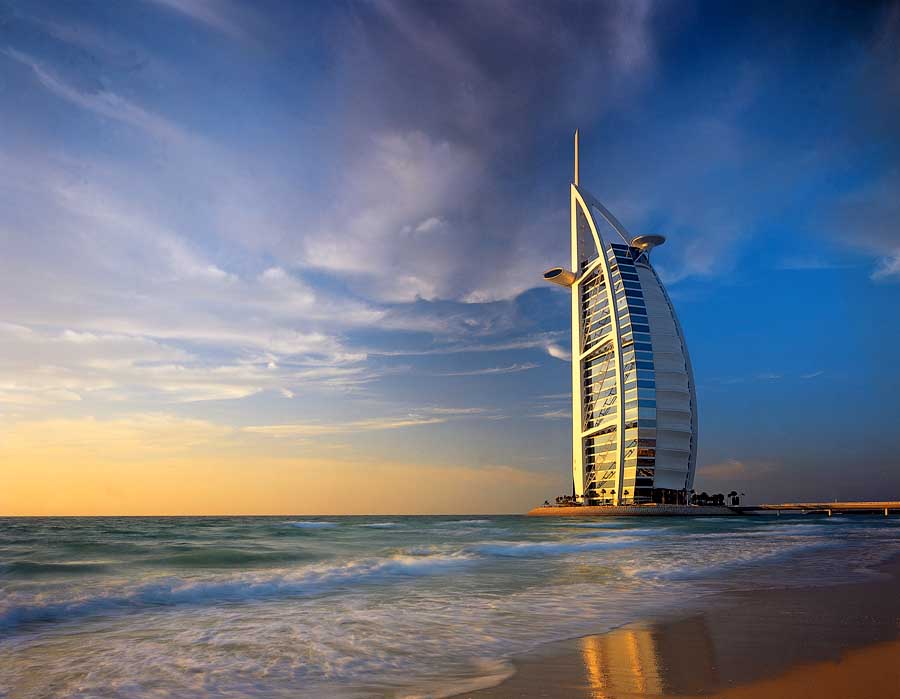
burj al arab jumeirah replacement image 2015
burj al arab jumeirah replacement image 2015, from:

(Note:  initial image used is no longer available, and was from: http://www.hotelrentalgroup.com/images/UAE-BaA1.jpg)

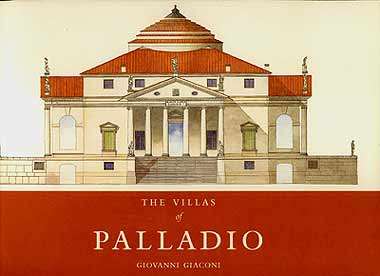
It is very interesting to compare cultural texts of different types; particularly so if the viewpoint is that of ‘cultural evolution’ (Balkin, preface, p.11) and if one chooses subjects from differing cultural groups and eras. This is achieved for example by comparing a current book about the rise and endurance of Palladianism with the recent movie “Factory Girl”. The film analyse the tragic life of Edie Sedgewick, a major muse of Andy Warhol. To then also compare the superb modern building ‘Burj Al Arab’ (see front-page illustration, above), and it is possible to see  each within their own cultural context and how each is totally different to the others. Yet all are premier products of zenith periods of a ‘high’ or ‘fine’ culture. It is particularly interesting to consider the impact metonym, metaphor and connotation have had on the development of messages, information and meanings that each of these unique cultural icons convey to the world . Use of these semiotic devices provides essential ‘cultural software’ (Balkin, preface, p. 11), which assists these strategically-designed commodities to ‘exist historically’ and thus have continuing international relevance.

Geeraerts tells us metonym is one major device serving to anchor the form of cultural commodities to their content, placing them firmly within their own cultural context, yet encouraging the modern, individual consumer, whether belonging to that culture or not, to construct a ‘metonymical path …to arrive at… [a] derived reading’. This device then allows the individual, and today’s society, to consider whether that cultural artefact is relevant and important today. (p.16). Reading ‘Palladio and Palladianism’ the book by Robert Taverner, shows this appears to be certainly the case both for the book itself and ‘Palladianism’.

This book not only demonstrates but also reinforces the myth of Palladianism, by telling us of the many, many ‘conscious revival’ (bringing back to life) of Pallidianism in other countries and other times’; Inigo Jones’ Colen Campbell and Lord Burlington, Thomas Jefferson. To these important cultural style-setters, all of whom created resounding influences in their own right, the adoption of Palladianism was ‘more than a matter of style, [it was] a way of life’. (back cover).

1.Palladio

http://www.arcspace.com/books/palladio/1.Palladio.jpg

Wikipedia tells us it is useful to compare metonymy with metaphor and says both ‘involve the substitution of one term for another’. Metaphor relies upon similarity, metonymy on contiguity. Taverner emphatically tells us in in Part One that discovery of one of Palladio’s villa is ‘sheer joy’. He does not tell us he feels ‘sheer joy’, he tells us that act of Palladian villa discovery ‘is sheer joy’. (p. 11)

Chandler says language is used is always growing, changing and certainly the website of the Free Library demonstrates just how semiotics, connotation, metonymy and metaphor play huge parts in the mystique that surrounds Palladianism and continuously increases:

‘indeed, the whole scene was like a classical landscape with a touch

of Watteau; the Palladian facade of the house pale in the moon, and

the same silver touching the very pagan and naked marble nymph

in the middle of the pond.’ (The Free Library)

Wikipedia’s definition tells us ‘metonymy is the evocation of the whole by a connection. It consists in using for the name of a thing a relationship, an attribute’. Further definitions state metonymy is a word that denotes one thing but refers to a related thing. wordnet.princeton.edu/perl/webwn. In rhetoric, metonymy is the substitution of one word for another word with which it is associated. http://en.wikipedia.org/wiki/Metonym

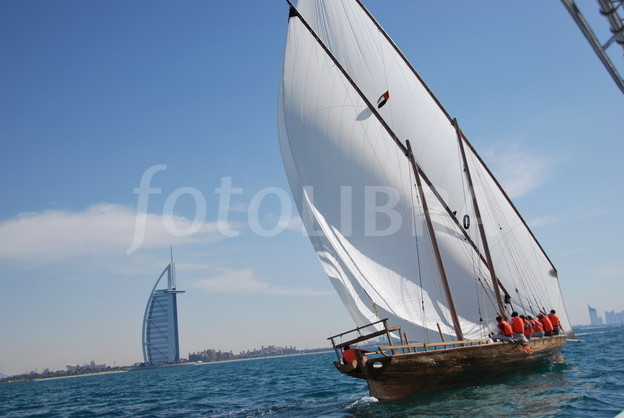
These definitions are borne out ff we look at the Burj or even a photograph of the ‘Burj’ below. To most people the connotations of this cultural text are not immediately those of a building. People talk about, and if they cannot physically see it in situ, imagine this construct as some type of huge, modern vessel. Generally they think of it as a metaphor,

Dhow racing off the Burj Al Arab
Dhow racing off the Burj Al Arab. (Image sourced, 2015 from:

http://gb.fotolibra.com/images/previews/528898-dhow-racing-off-the-burj-al-arab-dubai.jpeg)

(original image used no longer available in 2015, which was: http://keetsa.com/blog/wp-content/uploads/2007/06/dubai.jp)

They ‘see’ a sailship, standing at anchor on the calm shores of the Gulf, lying off the vibrant city of Dubai – of its time yet directly linked to the aesthetic stylisation of the 1800s ‘Orientalist’ period. This romantic craft is waiting there, glittering in the desert sunlight, ready to sail to exotic, exciting and unknown destinations. The exquisite positioning, and marketing, that has been conveyed both within the buildings’ own cultural context and also into the wider international community is, as Kress says:

“ in the area where culture can and does set its own rules…

and this is how ‘ …meaning is made” (Kress, 1998. p. 7).

This is the reason this building – and it’s image has such an impact worldwide. This is how “shared understandings arise, how cultures grow and spread, and how people of different cultures can understand and critique each other’s views” (Balkin).

Balkin says that ours is an age that always “absorb[s] the tools that lie to hand’…and that he uses …’metaphors because they are useful and in the hope that they will create a spark of recognition and excitement in others” This is what he means by ‘existi[ng] historically’.

The movie “Factory Girl” is constructed in such as way to send the message that Edie did just that; she certainly used the ‘tools that [were at] hand’, her own life, to create a ‘spark’ of revolution against mainstream culture. In doing so she developed her own unique counter cultural iconography.

Like Kurt Cobain, and because our culture values the individual and the works of the individual so highly it is still possible for Edie and her production to ‘exist historically’. The movie clearly sends us the message that killing herself by drug overdose was a part of her life’s great tapestry, making use of the ‘tools’ she had available. The movie confirms again today a message that was clear in the 70s; Edie lived her life as art: by putting herself so much at risk she effectively communicated her personal pain and her conflict with mainstream society. Her message resonated strongly and in a lasting fashion. She was then, and is still today, perceived as highly relevant.

‘Our culture is one which places enormously high value on

the individual and actions of the individual’. (Kress, 1998. p. 17).

Referring to Encarta we find the noun connotation carries implied additional meaning: an additional sense or senses associated with or suggested by a word or phrase. Sometimes, but not always, the meaning is fixed, and often subjective. Palladio created superb ideological structures that also continue to ‘exist historically’. By telling us these strictly adhere to ‘Nature[‘s]… rigorous laws’ Taverner’s book reinforces the ‘additional sense; Palladianism then and today is the foundation of ‘rational principles’ and Palladian buildings are ‘classical beauty in architecture’ ‘all’antica’, embodying the highest classical ideals of ‘utilitas, firmitas, and venustas’ (Taverner, p. 11 & 12).

In addition Encarta says connotation implies or suggests additional meaning for a word or phrase apart from the literal or main meaning. In logic, the characteristic or set of characteristics that makes up the meaning of a term defines the objects to which a term can be applied. The additional meanings, the ‘recognition and excitement’ attached to Edie’s cultural production defies logic:

Edie as art became firmly integrated into popular culture, the ‘youthquake’ of the 1960s. As Chandler says, ‘meaning is always permeated with value judgement’. (Boloshinov, V. as quoted by Chandler. P. 2). Today, thanks to her commitment to her personal narrative there are perceived meanings her life still carries and she stands, to many people as an important part of a major cultural watershed, now a landmark period in the development of Western contemporary art.

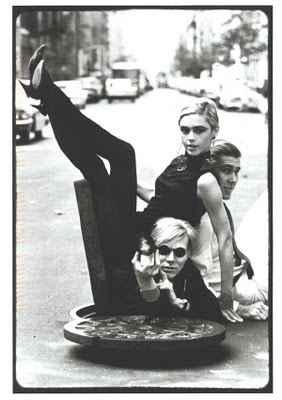
Edie Sedgewick, Andy Warhol, and Manhattan, NY manhole B/W shot

(Replacement image sourced in 2015,

from: https://nyjunkie.files.wordpress.com/2011/01/people-andy-warhol-in-manhole.jpg)

Edie Sedgewick, Andy Warhol & a Manhattan, NY manhole event
Edie Sedgewick, Andy Warhol & a Manhattan, NY manhole event. Sourced 2015, from:

(original image used in 2007 now not available, was from http://www.math.temple.edu/~jmaj/edie.jpg).

Certainly the Burj is also a superbly placed item of propaganda, unique and yet of all cultures and all times, something Islamic architecture mastered many eras ago. One could almost say with the Islamic invasion of the then-known world came the advent of the ‘history of globalised culture’. To ensure their continuing success – over very long periods of time – within the diverse cultures and communities they invaded and dominated, the Muslim high cultures adopted and perfected the reflexive art of entrenching additional meaning within their production of important cultural artefacts in ways that resonated, carried ‘additional meaning’ which Encarta tells us is one of the attributes of connotation.

BIBLIOGRAPHY

Books

Crouch, C. ((1999). Modernism in art, design & architecture.

Hampshire and London: Macmillan Press.

Inglis, D. (2007). Culture and everyday life. London: Routledge.

Kress, G. (1998). Communication and Culture. Sydney: UNSW Press.

Internet

Chandler, D. Semiotics for Beginners. Daniel Chandler. Denotation, Connotation and Myth

Last modified: 03/28/2002 14:21:20

http://www.aber.ac.uk/media/Documents/S4B/sem06.html).

http://encarta.msn.com/encnet/features/dictionary/DictionaryResults.aspx?refid=1861599676

Wikepedia

http://en.wikipedia.org/wiki/Metonym

Geeraerts, Dirk. 2002. “The interaction of metaphor and metonymy in composite

expressions”. In René Dirven & Ralf Pörings (red.), Metaphor and metonymy in comparison and contrast 435-465. Berlin: Mouton de Gruyter.

  1. Interactions between metaphor and metonymy in composite expressions

http://wwwling.arts.kuleuven.ac.be/qlvl/PDFPublications/02Theinteraction.pdf

Balkin, J. M. 1998. Cultural Software: A Theory of Ideology. Online version under a Creative Commons Noncommercial Sharealike license.

Published by Yale University Press

http://www.yale.edu/lawweb/jbalkin/cs.htm

Merriam-Webster Online Dictionary

http://www.m-w.com/dictionary/Palladianism

Palladian

: of or relating to a revived classical style in architecture based on the works of Andrea Palladio

Adj.     1.         Palladian – referring to or relating to or having the style of architecture created by Andrea Palladio; “the much imitated arch and column compositions known as the Palladian motif”

http://www.thefreedictionary.com/Palladian

The Free Library > Literature > Gilbert Chesterton > The Man Who Knew Too Much >     Chapter VI. The Hole In The Wall

http://chesterton.thefreelibrary.com/The-Man-Who-Knew-Too-Much/6-1#Palladian

classics.wlu.edu/literaryterms.html

wordnet.princeton.edu/perl/webwn

en.wikipedia.org/wiki/Metonym

http://www.google.com/search?hl=en&defl=en&q=define:Metonym&sa=X&oi=glossary_definition&ct=title

Cultural Software

http://www.yale.edu/lawweb/jher /cs.htm

Cultural Software explains ideology as a result of the cultural evolution of bits of cultural knowhow, or memes. It is the first book to apply theories of cultural evolution to the problem of ideology and justice.

‘of the major strands of post-modern thought. Theories of social psychology, narrative, semiotics, metaphor, and metonym are discussed sympathetically’

Cultural Software is now available in an online version under a Creative Commons Noncommercial Sharealike license.

Hardcover, 352 pages

Published by Yale University Press

Illustrations

  1. Weblog

Permalink

http://insearchofmyself.spaces.live.com/blog/cns!DFF727B67232D644!683.entry

http://images.google.com/imgres?imgurl=http://www.hotelrentalgroup.com/images/UAE-BaA1.jpg&imgrefurl=http://insearchofmyself.spaces.live.com/Blog/cns!DFF727B67232D644!683.entry&h=338&w=450&sz=30&hl=en&start=56&tbnid=f-g8IlLD4WbzbM:&tbnh=95&tbnw=127&prev=/images%3Fq%3DDubai%2Bbuildings%26start%3D42%26gbv%3D2%26ndsp%3D21%26svnum%3D10%26hl%3Den%26sa%3DNtp://images.google.com/imgres?imgurl=http://www.hotelrentalgroup.com/images/UAE-BaA1.jpg&imgrefurl=http://insearchofmyself.spaces.live.com/Blog/cns!DFF727B67232D644!683.entry&h=338&w=450&sz=30&hl=en&start=56&tbnid=f-g8IlLD4WbzbM:&tbnh=95&tbnw=127&prev=/images%3Fq%3DDubai%2Bbuildings%26start%3D42%26gbv%3D2%26ndsp%3D21%26svnum%3D10%26hl%3Den%26sa%3DN

Faking it in the fake city 1

Illustrations 2

http://www.arcspace.com/books/palladio/1.Palladio.jpg

http://www.math.temple.edu/~jmaj/edie.jpg

edie

Appendix:

FINAL Summary/Notes

Rebirth – p.11 Taverner Palladio

Discuss the idea of reflexivity in relation to individual cultural practices and

Burj – reflexive response to the excesses of oil boom of 70s and 80s

Two have already had a lasting impact; Palladio who lived in 15thC Italy has continued to have worldwide relevance and application. Edie (and Warhol), 60s America and their counter-contribution and inclusion within mainstream Western culture continues to be not only relived and replayed endlessly but also discussed and analysed, all on an international level, today. It remains to be seen whether the ‘Burj’ in today’s Dubai will retain its international social influence over the decades.

History of globalised culture

Burj – novel

Warhol – was novel and continuing

Palladio – novel in his time and continuing

Development of digital technology and its consequences

Because of this world-wide audience and market for Burj Warhol

Not so many Palladio

  1. In dot points list the qualities or attributes of connotation.

(All dot points listed below, except those attributed, are derived from Chandler, D. http://www.aber.ac.uk/media/Documents/S4B/sem06.html).

  • that containing the evaluative element, and aligned with symbolic, expressive values and attributes
  • connotation is related to myth, the transforming of history into nature and as such is above the processes of demystifying, decipherment and interpretation
  • Bartelby.com. The New Dictionary of Cultural Literacy. Third Edition 2002. 7. Conventions of Written English.

http://www.thefreedictionary.com/connotative states that

connotation is the meaning that a word suggests or implies

and includes the emotions or associations that surround a word.

and assist the creation of ‘cultural artefacts’ and

post-traditional period the only relationships that endure are those that have validity, whether they are personal or with cultural artefacts Giddens? Constant reflexiivity

Aside

Week8Assignmenttaskstakeholderinfoandsets

SUSANNE LORRAINE HARFORD

Week 8 Assignment Task

Journal Entry number 13

-Week 8 Activity

Complete the following task in your online journal.

1. Based on your selected client, what types of stakeholder information/data sets would be required to (list data sets and the ‘fields’ required for each):

a) Run your event

b) Assist to achieve business goals

2. How would you obtain the information for each of these data sets given you are running a non-ticketed event?

3. How will you recommend this data be used following your event to assist in achieving immediate and long term goals?

…………………………………………………………………………………………………………..

For the Seniors Expo special event

the types of stakeholder

information/data sets and fields required to

The types of stakeholder information/data sets and fields required are of key importance.

In order to decide the type of information I would examine and consider the objectives I have created for the Seniors Expo closely. I would also consider the creation/acquiring of key data like this from the PR perspective.

As I intend to stay away from any economic imperatives or objectives in this particular special event exercise, the data-collection/ analysis will also have an unusual focus for its objectives –

So, in this exercise my objectives are for every single stakeholder, of any type:

  • to have a good time and enjoy themselves
  • so every single stakeholder wants to return for the next Seniors Expo
  • to bring all their friends, family and associates.
  1. Thus, to run the Seniors Expo event the data includes:
  • Type of Stakeholders, including:
  • client
  • potential sponsors and partners
  • target market audience/s
  • contractors, consultants, staff, essential services, government,
  • media

The essential information about the Seniors Expo stakeholders falls within the areas of the “demography, psychography and behavior”

(Masterman & Wood, 2006, p. 160).

The Max Planck Institute (2015) operates “Online Social Networks Research” and freely provides many great tools. Using tools like these would be a great advantage. (see screenshotmaxplanck2015).

  1. To assist to achieve business goals
  • About the Market
  • size
  • types of prior attendees
  • who those prior attendees are
  • advertising forms that successfully reached those prior attendees
  • “any product preferences and buying patterns” about those prior attendees

(Masterman & Wood, 2006, p. 160)

  • prior media relationships and responses, contacts
  • About the Environment
  • Relevant weather patterns
  • Relevant Transport and parking resources available
  • any positive or negative feedback from those prior attendees
  • any information about the prior event
    • good news
    • any problems, especially emergencies, disasters

So, the creation of these, and any other databases, that can contribute to the event’s “effectiveness”, and its “efficiency” of operation (Masterman & Wood, 2006, p. 160).

……………………………………………………………………………………………

How would you obtain the information for each of these data sets given you are running a non-ticketed event?

In order to obtain the information for each of these data sets I would locate the types of information Masterman and Wood, (2006, pp. 160, 161) describe, below:

Various research methods can be applied in order to collect data and much can be sourced in the public domain. Financial accounts, trading and industry figures, market trends and forecasts, government reports, trade news media and marketing news media are all useful sources of information.

With that free-to-public information, I would create a number of different databases.

This would be using tools such as that IDRE at UCLA (2015) who below explain one of their data collection and use services, the codebook (also see attached: idrechart.png):

The codebook command was introduced in SPSS version 17.

It provides information about the variables in a dataset,

such as the type, variable labels, value labels, as well as

the number of cases in each level of categorical variables

and means and standard deviations of continuous variables.

This information can be as important as the data themselves,

because it helps to give meaning to the data.  Also, this

information can help you distinguish between two similar datasets.

(Idre at UCLA, 2015).

In addition, as time goes by, I would also load into these new databases I am creating all the information I gain access to over the course of the current Seniors Expo, as outlined in my plan over the last few week’s exercises and tasks, I plan to:

  • use optional wash-off tattoos on attendees at parking, trains and entry points
  • electronically record those bar codes to provide attendance numbers – use a programme like SPSS –(Appendix 1)
  • offer these identified Seniors Expo attendees a chance in a competition linked to Instagram/Facebook/Seniors Expo website/train/bus/parking information
  • Using the data from the point immediately above, extract information from what Netbase (2015) call “social listening”.
  • All these linkages are avenues to gain more detailed information.

So they must be given a great deal of thought about the ethics of these data-gathering and ethics must play a large part in how any data-gathering is set up.

……………………………………………………………………………………………………………….. 

  1. How will you recommend this data be used following your event to assist in achieving immediate and long term goals?

The main recommendations I make about using this data are:

  1. The original data and any initial analysis be compared to actual-event, on-the-

ground findings, post-event, especially in regard to the set goals

  1. That all data be carefully recorded and preserved, including :
  • Any analytical work linking the special event objectives to the data
  • All data, in its original form
  • Any comparative post-event analysis of the data and the initial analysis in the frame of achieving immediate and long-term goals
  1. Results from the comparative exercise be:
  • Acted upon, implemented,
  • Results be analysed carefully, recorded and preserved.
  • Data be maintained within easy access
  • At regular periods, the current statistics be actively compared to the historic data
  • Ensure the research, analysis and reflection, etcetera cycle continues
  • Executive decisions and actions flow from there

Reference

ECU PRN2124 off-campus, S2, 2015. BB Week 8 lectures and activities notes.

Idre at UCLA. (2015). http://statistics.ats.ucla.edu/stat/spss/faq/codebook.htm

Masterman, G. and Wood, E. H. (2006). Innovative Marketing Communication,

Strategies for the Events Industry. Oxford: Elsevier Butterworth Heinemann.

Max Planck Institute. (2015). Website. Online Social Networks Research:

http://socialnetworks.mpi-sws.org/data-imc2007.html

Netbase. (2015). Website. http://www.netbase.com/innovation-2/brand-

reputation-social-listening-can-make-break/

SPSS. (2015) Website. Data Collection Tools. http://www.spss-

tutorials.com/spss-what-is-it

APPENDIX

SPSS: Data Collection Tools – Overview Main Features

Now that we have a basic idea of how SPSS works, let’s take a look at what it can do. Following a typical project workflow, SPSS is suitable for

SPSS – What Is It?

Week8Assignmenttaskstakeholderinfoandsets