Book Review for GSM, ECU Student Guild Mag.

Book Review for GSM ECU Student Guild Magazine. (2011) by Susanne Lorraine Harford.

Book: Sam, Grace and the Shipwreck
Author: Michelle Gillespie
Illustrated by: Sonia Martinez
Published: 2011
Michelle Gillespie’s Sam, Grace and the Shipwreck is a classic Ripping Yarn children’s book, the true tale of an admirable, unselfish act of public virtue which earned the dashing hero and heroine each a handsome reward. In this era of fragmenting societies and cultures it is a valuable tool for children to learn key cultural ideas fundamental to the Australian way of life; to generously assist anyone in need and treat thy neighbour as thyself.
A real adventure book, the illustrations are exciting and full of movement, and the book demonstrates how powerful and productive a sympathetic relationship between man and beast can be. Two dashing horses that also star in the story are beautifully illustrated.
However, this is a teaching tool and many important, key factors are left unspoken. The true context of the hero is absent; what is the name of his tribe? Where is his traditional land? Even his name – Sam Isaacs – thoroughly European, gives the reader no clue.
There are no images of how his people lived in humpies made of sticks and bark, yet the life of the heroine is richly described and illustrated. Tragically the story does not explain a grant of 100 acres of freehold land to an Aboriginal, by the whites who had colonised his land, was a phenomenal exception to the policies of exclusion implacably hindering his race?
Hopefully this important information will be available at the month-long exhibition at the State Library of Western Australia, beginning 13 October, 2011.

251 words

Book Review for GSM, ECU Student Guild Mag.

9. LP W11 A Three design examples

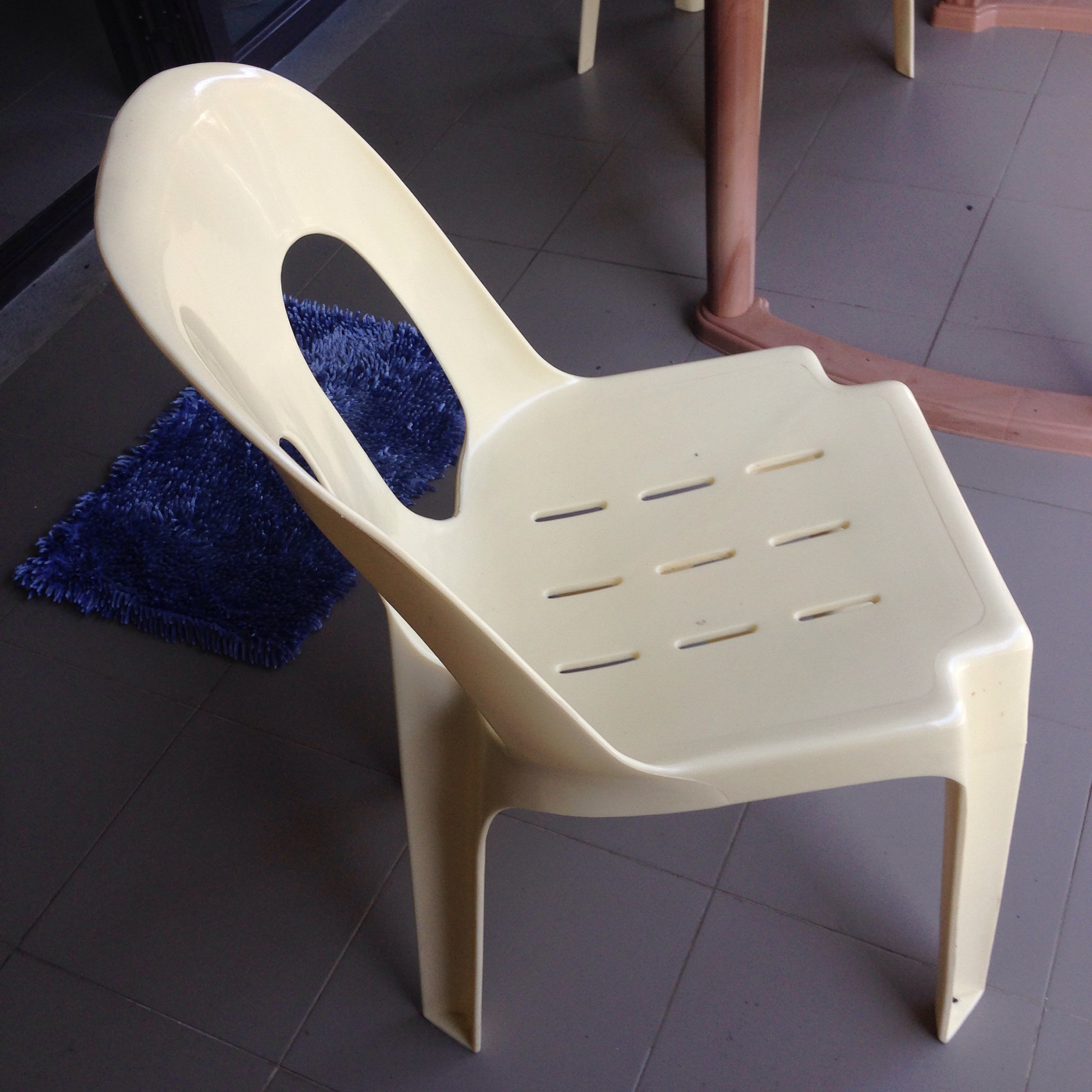
Little effort, mental or physical, is needed to use the  “virgin polypropylene” Pipee stacking chair (image 1). As it is extraordinarily light (Lifetime Industries website, 2015)  this chair fits the “kinematic… performance load” description (Lidwell, Holden and Butler 2003) . The chair design  is so familiar, so usable, that the makers can rely entirely on retained, long-term memories. The chair complies with “cognitive… performance load” – and the Lidwell, Holden and Butler “usability” criteria. As this is one of a set of four identical chairs it somehow fits these writers’ “consistency” definition. While touted as durable, ‘recycle’ appears nowhere on chairs or website. Aesthetics appears an alien concept, and Stahel’s (1982) “cradle to cradle” care and thought is probably unheard of .

Image 1. Pipee chair. S. Harford personal image, 2015.
Image 2. The Green Dot. S. Harford personal image, 2015.


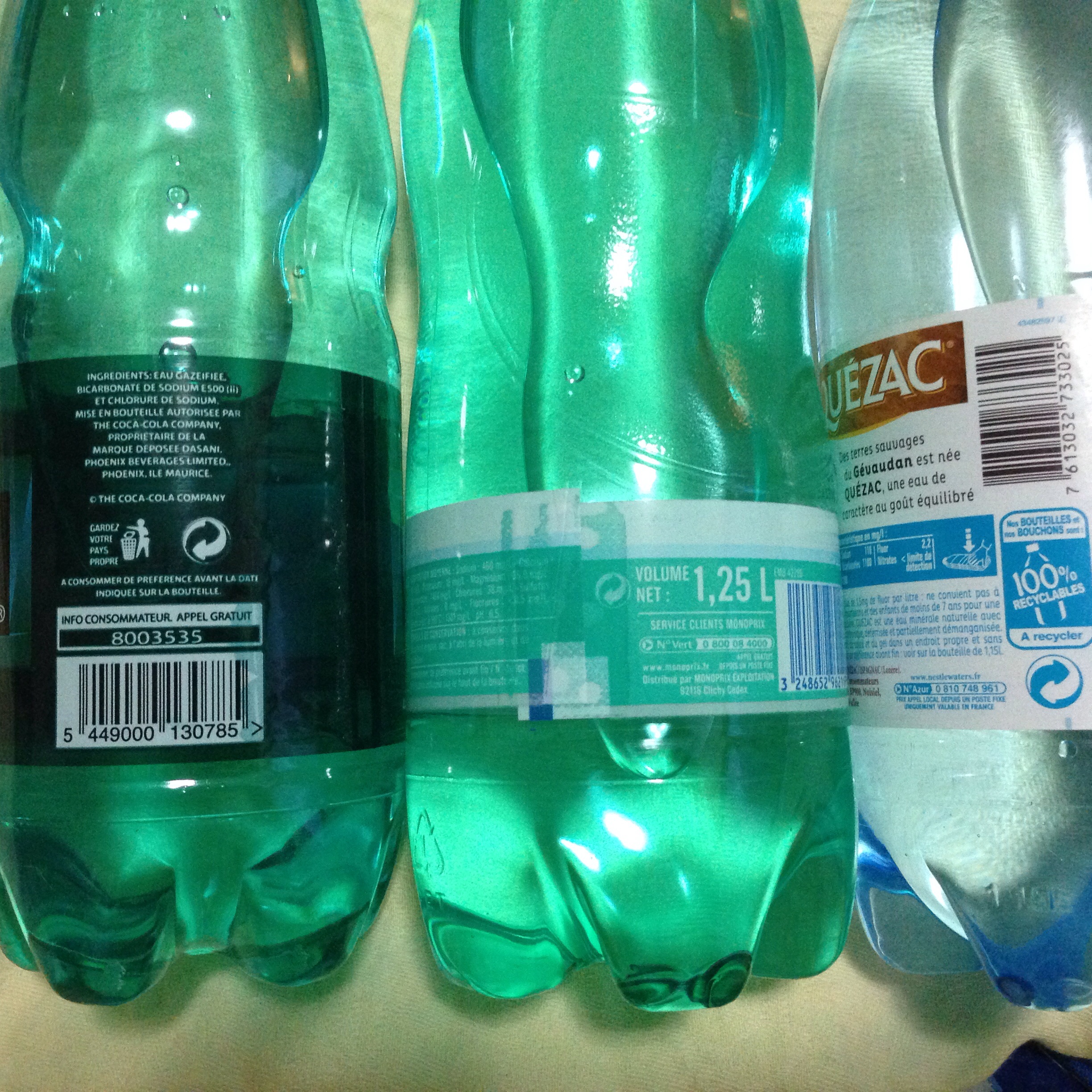
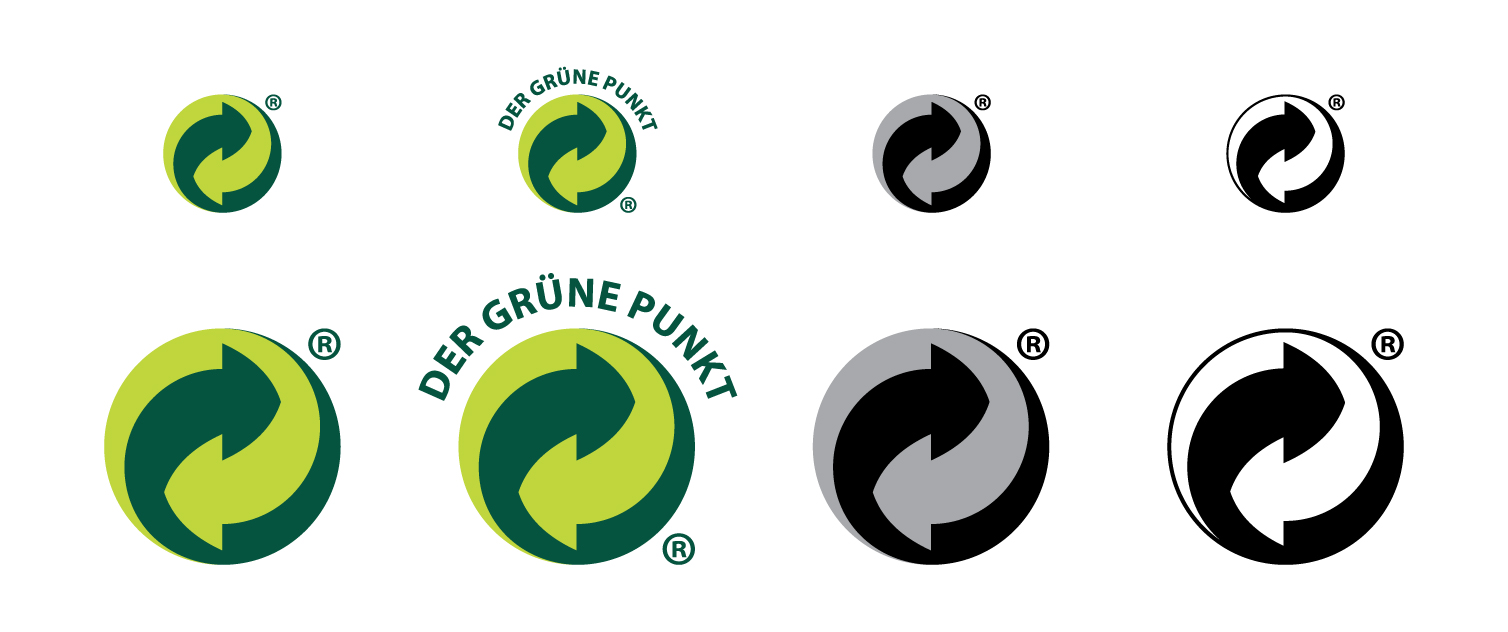
An enigmatic Green Dot Symbol (2015)  is in evidence (images 2 & 3) on the backs of three slightly-different-but-same and-performing-the-same plastic bottles of water. Symbols such as the Green Dot function like a logo – they carry a certain message. These messages are always “perceived” – correctly or incorrectly – in a certain way. So  this small symbol lightens, (for better or worse),  “mental … cognitive…  performance load”  (Lidwell, Holden & Butler, 2003).

Image 3. The Green Dot Symbol, 2015.


Image 3. Mauritius vongole. S. Harford personal image, 2015.
Image 4. Mauritius vongole. S. Harford personal image, 2015.

Image 4 shows is the former house of a most delicious creature. Always recognisable, all the same shape, colour and texture. The seeker’s performance, or cognitive load, is lessened, as, once seen and enjoyed they are forever recognisable. Regarding performance or kinematic load, again little effort is required.  Although these creatures may vary slightly in shape, all fit beautifully into the palm of a human hand and can easily be gathered into a bucket, and quickly pried open to eat, raw. Kinematic -performance load can be further reduced if steamed. Then all open obligingly – for ready access to their tasty  meat.

Reference 

Lifetime Industries. (2015). Pipee Stacking Chair. Website. Retrieved from http://www.lifetime.net.au/detail/pid/18/id/11/pipee-stacking-chairs

Harford, S. (2015). Personal images.

Stahel, W. R. (1982). The 30th. anniversary of Walter R. Stahel’s Prize-winning paper “The Product-Life-Factor”. Retrieved from http://www.product-life.org/en/the-30th-anniversary-of-walter-r-stahel-prize-winning-paper-the-product-life-factor

The Green Dot Symbol. (n.d.). Symbols.com. Retrieved May 25, 2015, from http://www.symbols.com/symbol/2025.

Aside

8. LP W11 Q3 Design and Psychology


 When considering whether psychology is necessary in the human world of design it is useful to read the APA, or American Psychological Association (2015) definition of psychology: the study of the mind and behavior… [which] embraces

all aspects of the human experience — from the functions of the

brain to the actions of nations, from child development to care for

the aged. In every conceivable setting from scientific research

centers to mental healthcare services,

“the understanding of behavior”

is the enterprise of psychologists.

Budd says all people already have automatic “psychological shortcuts… to basically avoid thinking” (cited by Richardson Taylor, n.d.). Thus it seems clear psychology has a role in anything – at all – designed for human use. Psychology in design is entrenched, as shown by the APA website (2015), which now has an entire section on Design Psychologists.

Lidwell, Holden and Butler (2003) also say “every major design concept” is based on universal principles of design which “influence [people’s] perception” and “increase [design] appeal”. Davis (cited by Richardson Taylor, n.d.) says:

psychology has a huge impact. Unlike artists, designers

have to make something for effect; an artist can start a

project without a brief, but a designer has to have a

purpose.

The successful designer considers, writer-psychologist Don Norman (2013) says: “the needs of users and the principles of cognitive psychology”. Norman supplies some simple rules:

make things visible, exploit natural relationships that couple

function and control, and make intelligent use of constraints.

The goal: guide the user effortlessly to the right action…

at the right time.

This advice is reinforced by James Digby-Jones, who says: “awareness of psychology can inform good design in very tangible ways” (cited by Richardson Taylor, n.d.).

Whether  psychology in design is necessary is irrelevant at this advance stage of psychological control of design. It may not be – in this age of “no commitments… no one idea is inherently better than any other” (Fuller, cited by Crouch, 1991, p. 169).. Furthermore, Lewington says (1 April, 2014), when discussing web design that psychologists  have identified trust as a key area in design success. Trust is hard to build and easily eroded. Today, human trust – in psychology’s part in human design – has probably  disappeared.

Reference

Crouch, C. (1991). Modernism in art, design & architecture. London: Palgrave Macmillan

American Psychological Association. (2015) Definition. Website. Retrieved from        http://www.apa.org/support/about/apa/psychology.aspx#answer.

Lewington, H. (1 April, 2014). The importance of psychology in web design. Issue 24, Net magazine. [On-line Magazine]. Retrieved from http://www.creativebloq.com/web-design/importance-psychology-7135530

Lidwell, W., Holden, K., & Butler, J. (2003). Aesthetic-Usability Effect. Universal principles of design. Massachusetts: Rockport. Retrieved from Learning Portfolio, S1, 2015.

Norman, D. (2013). The Design of Everyday Things. Revised and expanded edition. New York, NY, USA: Basic Books.

Richardson Taylor, A. (n.d.) The psychology of design explained. Digital Arts Online. [On-line Magazine]. http://www.digitalartsonline.co.uk/features/graphic-design/psychology-of-design-explained/

8. LP W11 Q3 Design and Psychology

7. LP WK 11 Q 2 Chunks

Cooper (December, 1998), says “Cognitive Science… is an instructional theory… [covering] the mental processes of learning, memory and problem solving”. He quotes some early theorists, “(e.g. Sweller, 1988; 1994)… the fundamental tenet of cognitive load theory is that the quality of instructional design will be raised if greater consideration is given to the role and limitations of working memory.”

Cooper (December, 1998) explains the design process does not rely on any “underlying meaning or logic” and  provides examples where if these “can be identified”  the meaning can be communicated in “chunks” of information.  This plan can be linked to the  “three metaphors of communication: transmission of information; ritual; transformation” (Pea, cited by Wilson & Cole, 1996). Pea says  transmission is “the dominant idea”  in the ritual of communication, where the content of the message is often less important than the medium and style of expression”.

These ideas about ritual, medium and style of delivery in some ways reflect the concept of aesthetic usability, including visual, in design – or, as Donald Norman (2002) says: “aesthetics matter… attractive things work better”. Cooper (December, 1998) explains when designing ‟a large set of elements to remember it is often helpful to combine the elements to form a smaller number of groups“.  In this “chunking” process Cooper (December, 1998) says each interior group becomes ‟a chunk“.

When chunking “sets of information” the consistency concept may be useful to consider, as  Lidwell, Holden and Butler, (20013) say “aesthetic consistency” can sometimes create an individual identity for information which helps it be remembered.So, in using  internal and external consistency (Lidwell, Holden and Butler, 20013) a styled transformation of the message may allow (both “the “sender” and) “receiver” of the information to open themselves up… to [further] inquiry, observation, and reflection” (Wilson & Cole, 1996). By incorporating aesthetic consistency into the information chunking process,  the chance of being “remembered  [in the important long-term memory may] be greatly enhanced”.

 Reference

Cole, P. and Wilson, B. G. (1996). Cognitive Teaching Models. New York, NY, USA: Scholastic Press.

Cooper, G. (December, 1998). Improving traditional instruction: Cognitive Load theory. Research into Cognitive Load Theory and Instructional Design at UNSW. Retrieved from           http://dwb4.unl.edu/Diss/Cooper/UNSW.htm

Lidwell, W., Holden, K., & Butler, J. (2003). Aesthetic-Usability Effect. Universal principles of design. Massachusetts: Rockport. Retrieved from Learning Portfolio Module 2, S1, 2015.

Norman, D. (2002). Emotion and design: Attractive things work better. Interactions Magazine. [On-line Magazine]. I (4), 36-42. Retrieved from jnd.org.

Wilson, B. G. & Cole, P. (1996). Cognitive teaching models. In D. H. Jonassen (ed.), Handbook of research for educational communications and technology. New York: Simon & Schuster MacMillan.


7. LP WK 11 Q 2 Chunks

6. LP W11 Q1: Performance Load

The article (Lidwell, Holden & Butler, 2003) is part of an established discourse of how

complicated tasks are more difficult to carry out successfully than are less complicated

tasks. However, Hall (1996, p. 292) says:

a discourse can be produced by many individuals in

different institutional settings (like families, prisons, hospitals

and asylums). Its integrity or `coherence´ does not depend

on whether or not it issues from one place or from a single

speaker or `subject´. Nevertheless, every discourse constructs

positions from which alone it makes sense.

While Lidwell, Holden and Butler (2003) explain how to “reduce cognitive load by… reduc[ing

and] “chunking information… automating… [and providing aids to assist] memory tasks”, and

so describe  “performance load” there is no consideration for the artistic view of work

(personal experience and conversations, 1957-2015). The previously-established data, for

example,  Miller (1956) “compare[s] results obtained in quite different

experimental situations”, and demonstrates the two types of performance load, cognitive

and kinematic,  discusses a subject that is also of deep enrichment to artisans, artists and

others (personal experience and conversations, 1957-2015). So Lidwell, Holden and Butler (2003) may

have overlooked those defined by the Government of Canada (2015) as:

primarily engaged in creating visual art and craft works… artistic

and cultural objects… made in small quantities, of any material.

The typical labour force is an artist, artisan or craftsperson,

sometimes assisted by other artists, artisans, craftspersons or

apprentices… independent photographers and journalists included.

In addition, while Brockman (5 July, 2015) quotes Coveney, that: “people have to go around

measuring… [work] … there’s a deep relationship between the two” this is not the only

viewpoint. Oxford Dictionaries (2015) defines the noun “”cognitive as “the mental action or process of acquiring knowledge

and understanding through thought, experience, and the senses”, Artistic individuals may want to immerse themselves in deep thought about their

occupation (personal experience and conversations, 1957-2015).


This situation also applies to the second performance factor, “kinematic” (Lidwell, Holden & Butler, 2003). A “plural

noun” defined by Oxford Dictionaries (2015) as “the branch of mechanics concerned with

the motion of objects without reference to the forces which cause the motion”.


Lidwell, Holden & Butler, 2003  provide techniques for kinematic load reduction. This they say

lessens “steps… [of] overall motion… [and automates] tasks”. Artisans and others may enjoy

and gain benefit from the many tasks their industry involves. They may reject the

performance load concept of work (personal experience and conversations, 1957-2015)

as the performance load reduction concept is not a primary concern for “those who

understand that their very nature is that of an artist” (McManus, 2014).

Reference

Brockman, (7 May, 2015). Popper versus Bacon. A conversation with Peter Coveney Edge. [On-line Magazine]. Retrieved from http://edge.org/
Government of Canada. (2015). Independent Visual Artists and Artisans Definition.Canadian Industry Statistics. Retrieved from https://strategis.ic.gc.ca/app/scr/sbms/sbb/cis/definition.html?code=711511&lang=eng
Hall, S. (1996). The West and the Rest. Formations of Modernity. Modernity: An introduction to modern societies. Hoboken, New Jersey, USA: John Wiley and Sons.
Lidwell, W., Holden, K., & Butler, J. (2003). Aesthetic-Usability Effect. Universal principles of design. Massachusetts: Rockport. Retrieved from Learning Portfolio Module 2, S1, 2015.
McManus, R. (2014). The Artisan Soul: Crafting your life into a work of art. New York, NY, USA: Harper One.
Miller, G. A. (Mar 1956). The magical number seven, plus or minus two: some limits on our capacity for processing information. Psychological Review. 63(2) 81-97. Retrieved from http://dx.doi.org/10.1037/h0043158
Oxford Dictionaries. (2015). Cognitive. Retrieved from http://www.oxforddictionaries.com/definition/english/cognition
Oxford Dictionaries. (2015). Kinematic. Retrieved from http://www.oxforddictionaries.com/definition/english/kinematics
6. LP W11 Q1: Performance Load