12. LP W12 Q3 Salient points: the Internet, democracy & the people

In order to properly answer the LP Week 12 Question 3 task it seemed necessary to first reflect on, describe, and then consider again the context of this complicated question. The result is a preamble posted in Forum 3.2, Discussion Board, dated Friday, 29 May, 2015.

List of Points that may affect credibility. If the Web in the future:

  • presents issues of exchange, or as (North, March, 1993) says: “the problem of creating institutions that can credibly commit the players to solve problems of exchange”
  • accepts the need for “liberal” and “participatory… democracy” (The Democracy Barometer, 2011)
  • supports “’democracy…[as]  a complex phenomenon, where minimalist measurement” is never enough (The Democracy Barometer, 2011)
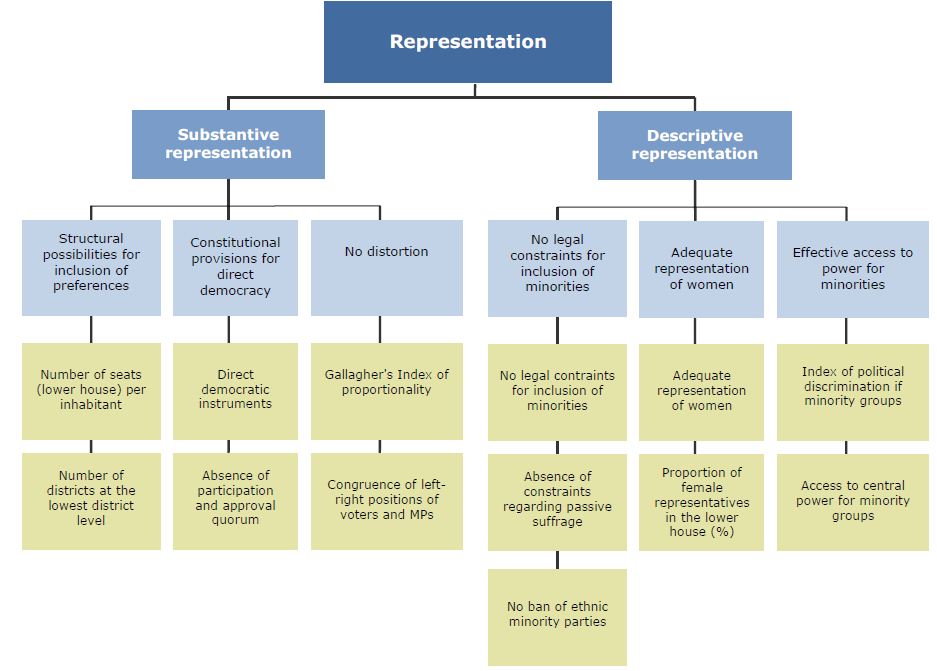
  • encourages and supports free and open public discussion about the development of democracy, such as in  Image 1, below, (The Democracy Barometer, 2011)
  • incorporates the demands for mass media communication accountability, (as is again being demanded of journalism), and “to take Citizen Demands into account: the complaints and wishes of citizens” (van der Wurff & Schoenbach, 20 June, 2014)
  • radically changes so the overall, fundamental ethos and operation of certain parts of the Internet are sheltered and away from persuasion and marketing
  • makes parts of the Internet “ad-free” environments (Webb, December, 2006)
  • commits to expend effort to understand, and incorporates and fully presents the populace’s most salient issues, and to support the people’s hierarchy of these issues
  • transparently presents important outcomes and welcomes discussion of matters such as those emanating from lack of ” trust in government”,  the “electoral process and democracy” (Hollander, 24 July 2014)
  • makes other, effective, channels of public, local and global communication available, free of charge, bias, and oppression
  • ensures equal, fair and widespread presentation of all types of websites – such as minority-owned, woman-owned and alternative.
Image 1. democracy barometer. 2014.

 Reference

Fogg, B. J. (2003). Credibility and the World Wide Web: Persuasive technology: Using computers to change what we think and do. Amsterdam: Morgan Kaufman Publishers.

Giddens, A. (1991). Modernity and Self: Identity: Self and society in the late modern age. Cambridge: Polity Press.

Hollander, B, A, (24 July, 2014). The Surprised Loser. The Role of Electoral Expectations and News Media Exposure in Satisfaction with Democracy. College of Journalism and Mass Communication, University of Georgia, 120 Hooper Street, Athens, GA 30602, USA. Journalism & Mass Communication Quarterly.  91(4), 651-668 doi: 10.1177/1077699014543380

Howard, P. N., & Smith, S. (2007 June) Channeling Diversity in the Public Spectrum: Who Qualifies to Bid for Which FCC Licenses?. 84 (2), 215-230. doi:10.1177/107769900708400202

Mayer, K. U. (19 November, 2004). Whose Lives? How history, societies, and institutions define and shape life courses. Research in Human Development, 1(3), 2004 161-187. doi 10.1207/s15427617rhd0103_3

North, D. C. (March, 1993). Institutions and credible commitment. Journal of Institutional and Theoretical Economics (JITE) / Zeitschrift für die gesamte Staatswissenschaft, 149(1). Retrieved from http://www.jstor.org/stable/40751576

OECD Statistics Portal. (2015). Definition of non-profit. OECD Glossary of Terms. Retrieved from https://stats.oecd.org/glossary/detail.asp?ID=1822

The Business Directory. (2015). Organization. Retrieved from http://www.businessdictionary.com/definition/organization.html#ixzz3bQuExgCa

The Business Directory. (2015). Website. Retrieved from http://www.businessdictionary.com/definition/website.html

The Democracy Barometer. (2011). Retrieved from http://www.democracybarometer.org/Images/img_feb13/RE_en.JPG

The Democracy Barometer. (2014). Retrieved from http://www.democracybarometer.org/

van der Wurff, R. & Schoenbach, K. (20 June, 2014). Civic and citizen demands of news media and journalists: What does the audience expect from good journalism? School of Communication Research, University of Amsterdam. Journalism & Mass Communication Quarterly. Doi 10.1177/1077699014538974

Webb, S. M. (December, 2006). The narrative of core traditional values in Reiman magazines. Journalism & Mass Communication Quarterly, 83(4), 865-882 doi 10.1177/107769900608300409

Aside

11. LP W12 Q2 Wikipedia

Wikipedia calls itself “a special kind of website” (2015). When researching many subjects today it is common to find this special website occupying top positions in many Google results. Yet, as as Ducet Rand (2010) says:

the encyclopedia is openly edited by registered users. Wikipedia editors can edit their own and others entries, and some abuse of      this editorial power has been unveiled. Content editors have also   been criticized for publishing less than accurate content.

This is possibly why, for some years now, ECU has banned the use of Wikipedia, which is also an application.  Haque and Ahamed (November, 2006) say:

The usability and expansion of pervasive computing applications depends greatly on the security and reliability provided by the applications… as pervasive devices become incorporated in our day-to-day lives, security will increasingly become a common concern for all users – though for most it will be an afterthought – like many other computing functions.

Haque and Ahamed (November, 2006) continue with an analysis of security:

CIA (Confidentiality, Integrity, Availability) is the term commonly used to describe the required characteristics of security. Confidentiality ensures information is not exposed to any unauthorized user. Integrity indicates information has not been altered or falsified by an unauthorized user.

Wikipedia security has been of concern to many for some time.  Kittur, Chi, Pendleton, Suh & Mytkowicz (2006), say the situation is extremely complex. They explain, initially, (until 2004), individuals they describe as “elite users” carried out the majority of the work constructing Wikipedia. At that point a noticeable change occurred as “common users” took over and the “influence of the elite” fell away. Then also, a process of removing more words than contributing commenced, for the first time.

It seems Wikipedia problems may have developed as the “always readily available” Internet developed (Haque & Ahamed, 2006).  Wikipedia supplied Haque and Ahamed a vital reference in 2006, when “Wikipedia defines security as a “… platform, designed so that agents (users or programs) can only perform actions that have been allowed. This involves specifying and implementing a security policy””. However, as Haque and Ahamed go on to explain:

security in pervasive computing has been termed pervasive security.     Though pervasive security includes all the characteristics and requirements of computer security, it introduces some novel vulnerabilities and security rifts due to a few unique characteristics of pervasive computing.

Haque and Ahamed team the Wikipedia definition with Microsoft’s: “The protection of information assets through the use of technology, processes, and training” – on a vast system with unique, ubiquitous “vulnerabilities”. where Wikipedia itself may be a ubiquitous “mobile or embedded in the environment… security rift”  (Haque & Ahamed, 2006).

Haque and Ahamed (2006) discusses the  “transparent interaction of these computational devices with the users”, but, given the Wikipedia editorial abuse,  Now Wikipedia seems the opposite of the Haque and Ahamed (2006) view in that it now is capable of delivering a unique, ubiquitous type of “virtual reality” information service.

Reference

Doucet Rand. (2010). Mediating at the student-Wikipedia intersection. .Journal of Library Administration. 50 (7-8) 2010. 923-932  doi 10.1080/01930826.2010.488994

Haque, M., and Ahamed, S. I. November, (2006). Availability of Security in Pervasive Computing: Current Status and Open Issues. Marquette University. International Journal of Network Security 3  203–214 . Retrieved from http://www.researchgate.net/profile/Md_Haque23/publication/45728848_Security_in_Pervasive_Computing_Current_Status_and_Open_Issues/links/00b4952cc56091881b000000.pdf

Kittur, A.; Chi, E. H,; Pendleton, B. A. ; Suh, B. ; Mytkowicz, T. (2007).  Power of the few vs. wisdom of the crowd: Wikipedia and the rise of the bourgeoisie. Retrieved from https://www.parc.com/publication/1749/power-of-the-few-vs-wisdom-of-the-crowd.html

Wikipedia. (2015). What is Wikipedia? Retrieved from http://en.wikipedia.org/wiki/Wikipedia:Introduction

Aside

10. LP W12 Q1

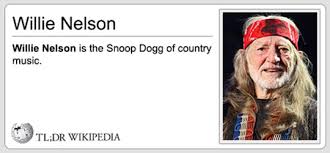
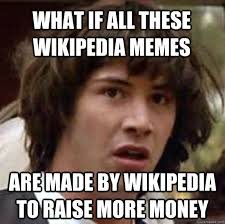
While on the Web, Wikipedia memes, (Images 1& 2) and discussion of same (Wikija, 2015) rightly amuse many, the many scholarly articles about  “a lack of credibility” on the Web, (World Wide Web),

Image 1. Lolz. Wikipedia mem, 2015.


Image 2. Quickmeme,Keanu Reeves image, 2015.
Image 2. Quickmeme, Keanu Reeves image, 2015.

and how this situation might be combated (Ribiero, Carmo, & de Caravalho, 2013) are an entirely different matter. The Oxford English Dictionary defines credibility as “the quality of being trusted and believed in; the quality of being convincing or believable”.

As “flaws and negative external influences” in key information appear on the Web, this quality, previously one of Western society’s most valued and defining characteristics, is  degraded,  The Web is the major mass media medium of this era so this problem affects anyone who wishes to learn or to be informed. This is because the Web is, as Kevin Kelly, founder of Wired magazine, said in 2005:

the largest, most complex, most surprising event on the planet.

Weaving nerves out of glass and radio waves, our species began

wiring up all regions, all processes, all facts and notions into a

grand network. From this embroyonic net was born a

collabororative interface for our civilization, a sensing, cognitive

device with power that exceeded any previous invention.

As Western society’s main communications channel the Web is tremendously important. Yet the stated rationale of Fogg’s (2003) paper is primarily to “persuade”, and the article by Ribiero, Carmo and de Caravalho (2013) appears, fundamentally, only to make the Web more efficient as a marketing machine. A Web cluttered with material biased solely towards  persuasion or marketing is counter-productive for any student – and unlikely to regain credibility.

Reference.

Fogg, J. (2003). Credibility and the World Wide Web. Persuasive Technolgy: Using computers to change what we think and do. Amsterdam: Morgan Kaufman Publishers. Retrieved from Learning Portfolio, S1, 2015.

Kelly, K. (2005). We are the Web. Wired. Issue 13.8. [On-line Magazine]. Retrieved from http://archive.wired.com/wired/archive/13.08/tech.html

Lolzbook. (2015). Meme using Willy Nelson image. Retrieved from http://lolzbook.com/page/1749/

Oxford Dictionaries. (2015). Credibility. Retrieved from http://www.oxforddictionaries.com/definition/english/credibility

Quickmeme. (2015). Meme using Keanu Reeves image. Retrieved from http://www.quickmeme.com/meme/35ficb

Ribiero, A. M., Carmo, C. H. S., & de Caravalho, L. N. G. (2013). Environmental disclosure: does regulation solve the lack of comparability and objectivity? Journal of accounting and organisations. Retrieved from  http://dx.doi.org/10.11606%2Frco.v7i17.56667

Wikja. (2015). Conspiracy Keanu: The Funniest Wiki. Retrieved from http://thefunnyist.wikia.com/wiki/Conspiracy_Keanu

Aside