Susanne Harford, 2007.
Student Number 10043898
Assessment Three
Lecturer: David PRESCOTT-STEED
Tutor: Sue Starcken


It is very interesting to compare cultural texts of different types; particularly so if the viewpoint is that of ‘cultural evolution’ (Balkin, preface, p.11) and if one chooses subjects from differing cultural groups and eras. This is achieved for example by comparing a current book about the rise and endurance of Palladianism with the recent movie “Factory Girl”. The film analyse the tragic life of Edie Sedgewick, a major muse of Andy Warhol. To then also compare the superb modern building ‘Burj Al Arab’ (see front-page illustration, above), and it is possible to see each within their own cultural context and how each is totally different to the others. Yet all are premier products of zenith periods of a ‘high’ or ‘fine’ culture. It is particularly interesting to consider the impact metonym, metaphor and connotation have had on the development of messages, information and meanings that each of these unique cultural icons convey to the world . Use of these semiotic devices provides essential ‘cultural software’ (Balkin, preface, p. 11), which assists these strategically-designed commodities to ‘exist historically’ and thus have continuing international relevance.
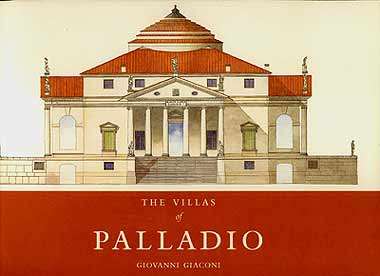
Geeraerts tells us metonym is one major device serving to anchor the form of cultural commodities to their content, placing them firmly within their own cultural context, yet encouraging the modern, individual consumer, whether belonging to that culture or not, to construct a ‘metonymical path …to arrive at… [a] derived reading’. This device then allows the individual, and today’s society, to consider whether that cultural artefact is relevant and important today. (p.16). Reading ‘Palladio and Palladianism’ the book by Robert Taverner, shows this appears to be certainly the case both for the book itself and ‘Palladianism’.
This book not only demonstrates but also reinforces the myth of Palladianism, by telling us of the many, many ‘conscious revival’ (bringing back to life) of Pallidianism in other countries and other times’; Inigo Jones’ Colen Campbell and Lord Burlington, Thomas Jefferson. To these important cultural style-setters, all of whom created resounding influences in their own right, the adoption of Palladianism was ‘more than a matter of style, [it was] a way of life’. (back cover).
http://www.arcspace.com/books/palladio/1.Palladio.jpg
Wikipedia tells us it is useful to compare metonymy with metaphor and says both ‘involve the substitution of one term for another’. Metaphor relies upon similarity, metonymy on contiguity. Taverner emphatically tells us in in Part One that discovery of one of Palladio’s villa is ‘sheer joy’. He does not tell us he feels ‘sheer joy’, he tells us that act of Palladian villa discovery ‘is sheer joy’. (p. 11)
Chandler says language is used is always growing, changing and certainly the website of the Free Library demonstrates just how semiotics, connotation, metonymy and metaphor play huge parts in the mystique that surrounds Palladianism and continuously increases:
‘indeed, the whole scene was like a classical landscape with a touch
of Watteau; the Palladian facade of the house pale in the moon, and
the same silver touching the very pagan and naked marble nymph
in the middle of the pond.’ (The Free Library)
Wikipedia’s definition tells us ‘metonymy is the evocation of the whole by a connection. It consists in using for the name of a thing a relationship, an attribute’. Further definitions state metonymy is a word that denotes one thing but refers to a related thing. wordnet.princeton.edu/perl/webwn. In rhetoric, metonymy is the substitution of one word for another word with which it is associated. http://en.wikipedia.org/wiki/Metonym
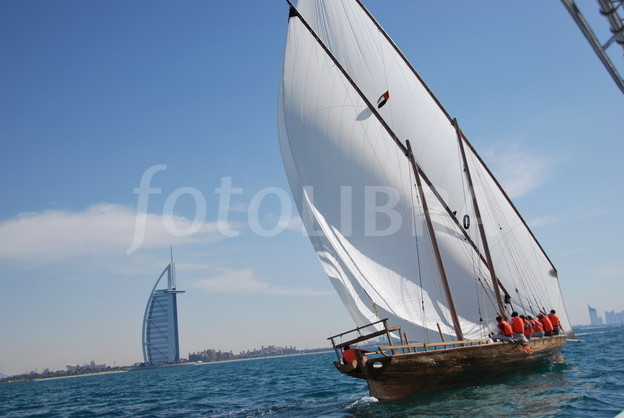
These definitions are borne out ff we look at the Burj or even a photograph of the ‘Burj’ below. To most people the connotations of this cultural text are not immediately those of a building. People talk about, and if they cannot physically see it in situ, imagine this construct as some type of huge, modern vessel. Generally they think of it as a metaphor,
http://gb.fotolibra.com/images/previews/528898-dhow-racing-off-the-burj-al-arab-dubai.jpeg)
(original image used no longer available in 2015, which was: http://keetsa.com/blog/wp-content/uploads/2007/06/dubai.jp)
They ‘see’ a sailship, standing at anchor on the calm shores of the Gulf, lying off the vibrant city of Dubai – of its time yet directly linked to the aesthetic stylisation of the 1800s ‘Orientalist’ period. This romantic craft is waiting there, glittering in the desert sunlight, ready to sail to exotic, exciting and unknown destinations. The exquisite positioning, and marketing, that has been conveyed both within the buildings’ own cultural context and also into the wider international community is, as Kress says:
“ in the area where culture can and does set its own rules…
and this is how ‘ …meaning is made” (Kress, 1998. p. 7).
This is the reason this building – and it’s image has such an impact worldwide. This is how “shared understandings arise, how cultures grow and spread, and how people of different cultures can understand and critique each other’s views” (Balkin).
Balkin says that ours is an age that always “absorb[s] the tools that lie to hand’…and that he uses …’metaphors because they are useful and in the hope that they will create a spark of recognition and excitement in others” This is what he means by ‘existi[ng] historically’.
The movie “Factory Girl” is constructed in such as way to send the message that Edie did just that; she certainly used the ‘tools that [were at] hand’, her own life, to create a ‘spark’ of revolution against mainstream culture. In doing so she developed her own unique counter cultural iconography.
Like Kurt Cobain, and because our culture values the individual and the works of the individual so highly it is still possible for Edie and her production to ‘exist historically’. The movie clearly sends us the message that killing herself by drug overdose was a part of her life’s great tapestry, making use of the ‘tools’ she had available. The movie confirms again today a message that was clear in the 70s; Edie lived her life as art: by putting herself so much at risk she effectively communicated her personal pain and her conflict with mainstream society. Her message resonated strongly and in a lasting fashion. She was then, and is still today, perceived as highly relevant.
‘Our culture is one which places enormously high value on
the individual and actions of the individual’. (Kress, 1998. p. 17).
Referring to Encarta we find the noun connotation carries implied additional meaning: an additional sense or senses associated with or suggested by a word or phrase. Sometimes, but not always, the meaning is fixed, and often subjective. Palladio created superb ideological structures that also continue to ‘exist historically’. By telling us these strictly adhere to ‘Nature[‘s]… rigorous laws’ Taverner’s book reinforces the ‘additional sense; Palladianism then and today is the foundation of ‘rational principles’ and Palladian buildings are ‘classical beauty in architecture’ ‘all’antica’, embodying the highest classical ideals of ‘utilitas, firmitas, and venustas’ (Taverner, p. 11 & 12).
In addition Encarta says connotation implies or suggests additional meaning for a word or phrase apart from the literal or main meaning. In logic, the characteristic or set of characteristics that makes up the meaning of a term defines the objects to which a term can be applied. The additional meanings, the ‘recognition and excitement’ attached to Edie’s cultural production defies logic:
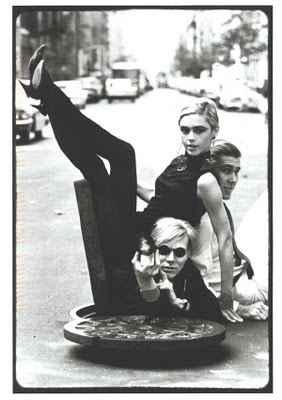
Edie as art became firmly integrated into popular culture, the ‘youthquake’ of the 1960s. As Chandler says, ‘meaning is always permeated with value judgement’. (Boloshinov, V. as quoted by Chandler. P. 2). Today, thanks to her commitment to her personal narrative there are perceived meanings her life still carries and she stands, to many people as an important part of a major cultural watershed, now a landmark period in the development of Western contemporary art.
(Replacement image sourced in 2015,
from: https://nyjunkie.files.wordpress.com/2011/01/people-andy-warhol-in-manhole.jpg)


(original image used in 2007 now not available, was from http://www.math.temple.edu/~jmaj/edie.jpg).
Certainly the Burj is also a superbly placed item of propaganda, unique and yet of all cultures and all times, something Islamic architecture mastered many eras ago. One could almost say with the Islamic invasion of the then-known world came the advent of the ‘history of globalised culture’. To ensure their continuing success – over very long periods of time – within the diverse cultures and communities they invaded and dominated, the Muslim high cultures adopted and perfected the reflexive art of entrenching additional meaning within their production of important cultural artefacts in ways that resonated, carried ‘additional meaning’ which Encarta tells us is one of the attributes of connotation.
BIBLIOGRAPHY
Books
Crouch, C. ((1999). Modernism in art, design & architecture.
Hampshire and London: Macmillan Press.
Inglis, D. (2007). Culture and everyday life. London: Routledge.
Kress, G. (1998). Communication and Culture. Sydney: UNSW Press.
Internet
Chandler, D. Semiotics for Beginners. Daniel Chandler. Denotation, Connotation and Myth
Last modified: 03/28/2002 14:21:20
http://www.aber.ac.uk/media/Documents/S4B/sem06.html).
http://encarta.msn.com/encnet/features/dictionary/DictionaryResults.aspx?refid=1861599676
Wikepedia
http://en.wikipedia.org/wiki/Metonym
Geeraerts, Dirk. 2002. “The interaction of metaphor and metonymy in composite
expressions”. In René Dirven & Ralf Pörings (red.), Metaphor and metonymy in comparison and contrast 435-465. Berlin: Mouton de Gruyter.
- Interactions between metaphor and metonymy in composite expressions
http://wwwling.arts.kuleuven.ac.be/qlvl/PDFPublications/02Theinteraction.pdf
Balkin, J. M. 1998. Cultural Software: A Theory of Ideology. Online version under a Creative Commons Noncommercial Sharealike license.
Published by Yale University Press
http://www.yale.edu/lawweb/jbalkin/cs.htm
Merriam-Webster Online Dictionary
http://www.m-w.com/dictionary/Palladianism
Palladian
: of or relating to a revived classical style in architecture based on the works of Andrea Palladio
Adj. 1. Palladian – referring to or relating to or having the style of architecture created by Andrea Palladio; “the much imitated arch and column compositions known as the Palladian motif”
http://www.thefreedictionary.com/Palladian
The Free Library > Literature > Gilbert Chesterton > The Man Who Knew Too Much > Chapter VI. The Hole In The Wall
http://chesterton.thefreelibrary.com/The-Man-Who-Knew-Too-Much/6-1#Palladian
classics.wlu.edu/literaryterms.html
wordnet.princeton.edu/perl/webwn
http://www.google.com/search?hl=en&defl=en&q=define:Metonym&sa=X&oi=glossary_definition&ct=title
Cultural Software
http://www.yale.edu/lawweb/jher /cs.htm
Cultural Software explains ideology as a result of the cultural evolution of bits of cultural knowhow, or memes. It is the first book to apply theories of cultural evolution to the problem of ideology and justice.
‘of the major strands of post-modern thought. Theories of social psychology, narrative, semiotics, metaphor, and metonym are discussed sympathetically’
Cultural Software is now available in an online version under a Creative Commons Noncommercial Sharealike license.
Hardcover, 352 pages
Published by Yale University Press
Illustrations
- Weblog
Permalink
http://insearchofmyself.spaces.live.com/blog/cns!DFF727B67232D644!683.entry
Faking it in the fake city 1
Illustrations 2

http://www.arcspace.com/books/palladio/1.Palladio.jpg
http://www.math.temple.edu/~jmaj/edie.jpg
edie
Appendix:
FINAL Summary/Notes
Rebirth – p.11 Taverner Palladio
Discuss the idea of reflexivity in relation to individual cultural practices and
Burj – reflexive response to the excesses of oil boom of 70s and 80s
Two have already had a lasting impact; Palladio who lived in 15thC Italy has continued to have worldwide relevance and application. Edie (and Warhol), 60s America and their counter-contribution and inclusion within mainstream Western culture continues to be not only relived and replayed endlessly but also discussed and analysed, all on an international level, today. It remains to be seen whether the ‘Burj’ in today’s Dubai will retain its international social influence over the decades.
History of globalised culture
Burj – novel
Warhol – was novel and continuing
Palladio – novel in his time and continuing
Development of digital technology and its consequences
Because of this world-wide audience and market for Burj Warhol
Not so many Palladio
- In dot points list the qualities or attributes of connotation.
(All dot points listed below, except those attributed, are derived from Chandler, D. http://www.aber.ac.uk/media/Documents/S4B/sem06.html).
- that containing the evaluative element, and aligned with symbolic, expressive values and attributes
- connotation is related to myth, the transforming of history into nature and as such is above the processes of demystifying, decipherment and interpretation
- Bartelby.com. The New Dictionary of Cultural Literacy. Third Edition 2002. 7. Conventions of Written English.
http://www.thefreedictionary.com/connotative states that
connotation is the meaning that a word suggests or implies
and includes the emotions or associations that surround a word.
and assist the creation of ‘cultural artefacts’ and
post-traditional period the only relationships that endure are those that have validity, whether they are personal or with cultural artefacts Giddens? Constant reflexiivity
 susanneah


