In order to properly answer the LP Week 12 Question 3 task it seemed necessary to first reflect on, describe, and then consider again the context of this complicated question. The result is a preamble posted in Forum 3.2, Discussion Board, dated Friday, 29 May, 2015.
List of Points that may affect credibility. If the Web in the future:
- presents issues of exchange, or as (North, March, 1993) says: “the problem of creating institutions that can credibly commit the players to solve problems of exchange”
- accepts the need for “liberal” and “participatory… democracy” (The Democracy Barometer, 2011)
- supports “’democracy…[as] a complex phenomenon, where minimalist measurement” is never enough (The Democracy Barometer, 2011)
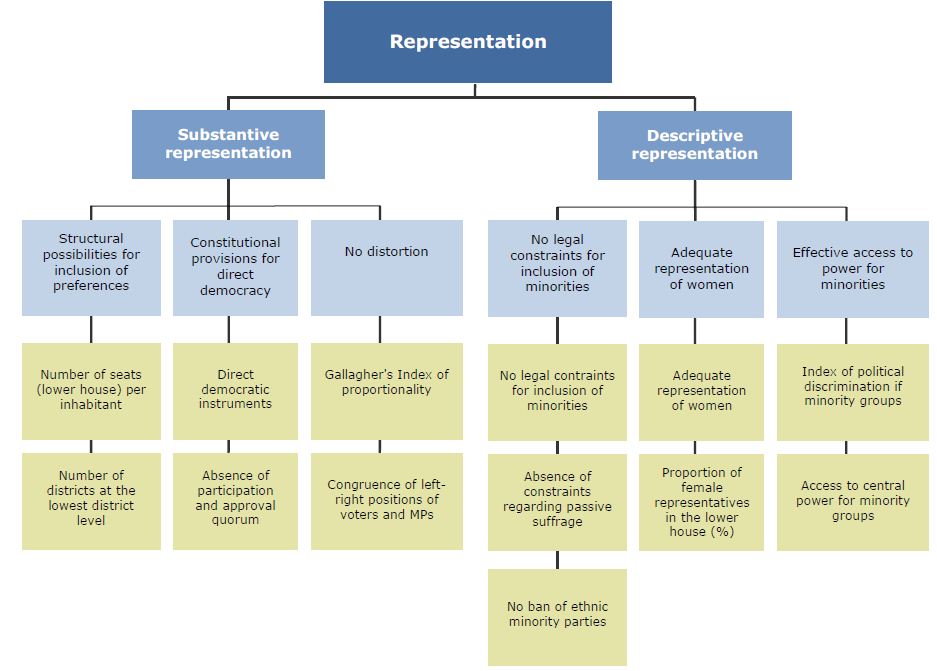
- encourages and supports free and open public discussion about the development of democracy, such as in Image 1, below, (The Democracy Barometer, 2011)
- incorporates the demands for mass media communication accountability, (as is again being demanded of journalism), and “to take Citizen Demands into account: the complaints and wishes of citizens” (van der Wurff & Schoenbach, 20 June, 2014)
- radically changes so the overall, fundamental ethos and operation of certain parts of the Internet are sheltered and away from persuasion and marketing
- makes parts of the Internet “ad-free” environments (Webb, December, 2006)
- commits to expend effort to understand, and incorporates and fully presents the populace’s most salient issues, and to support the people’s hierarchy of these issues
- transparently presents important outcomes and welcomes discussion of matters such as those emanating from lack of ” trust in government”, the “electoral process and democracy” (Hollander, 24 July 2014)
- makes other, effective, channels of public, local and global communication available, free of charge, bias, and oppression
- ensures equal, fair and widespread presentation of all types of websites – such as minority-owned, woman-owned and alternative.
Reference
Fogg, B. J. (2003). Credibility and the World Wide Web: Persuasive technology: Using computers to change what we think and do. Amsterdam: Morgan Kaufman Publishers.
Giddens, A. (1991). Modernity and Self: Identity: Self and society in the late modern age. Cambridge: Polity Press.
Hollander, B, A, (24 July, 2014). The Surprised Loser. The Role of Electoral Expectations and News Media Exposure in Satisfaction with Democracy. College of Journalism and Mass Communication, University of Georgia, 120 Hooper Street, Athens, GA 30602, USA. Journalism & Mass Communication Quarterly. 91(4), 651-668 doi: 10.1177/1077699014543380
Howard, P. N., & Smith, S. (2007 June) Channeling Diversity in the Public Spectrum: Who Qualifies to Bid for Which FCC Licenses?. 84 (2), 215-230. doi:10.1177/107769900708400202
Mayer, K. U. (19 November, 2004). Whose Lives? How history, societies, and institutions define and shape life courses. Research in Human Development, 1(3), 2004 161-187. doi 10.1207/s15427617rhd0103_3
North, D. C. (March, 1993). Institutions and credible commitment. Journal of Institutional and Theoretical Economics (JITE) / Zeitschrift für die gesamte Staatswissenschaft, 149(1). Retrieved from http://www.jstor.org/stable/40751576
OECD Statistics Portal. (2015). Definition of non-profit. OECD Glossary of Terms. Retrieved from https://stats.oecd.org/glossary/detail.asp?ID=1822
The Business Directory. (2015). Organization. Retrieved from http://www.businessdictionary.com/definition/organization.html#ixzz3bQuExgCa
The Business Directory. (2015). Website. Retrieved from http://www.businessdictionary.com/definition/website.html
The Democracy Barometer. (2011). Retrieved from http://www.democracybarometer.org/Images/img_feb13/RE_en.JPG
The Democracy Barometer. (2014). Retrieved from http://www.democracybarometer.org/
van der Wurff, R. & Schoenbach, K. (20 June, 2014). Civic and citizen demands of news media and journalists: What does the audience expect from good journalism? School of Communication Research, University of Amsterdam. Journalism & Mass Communication Quarterly. Doi 10.1177/1077699014538974
Webb, S. M. (December, 2006). The narrative of core traditional values in Reiman magazines. Journalism & Mass Communication Quarterly, 83(4), 865-882 doi 10.1177/107769900608300409


 susanneah